Book Summary: “Masters of Scale”
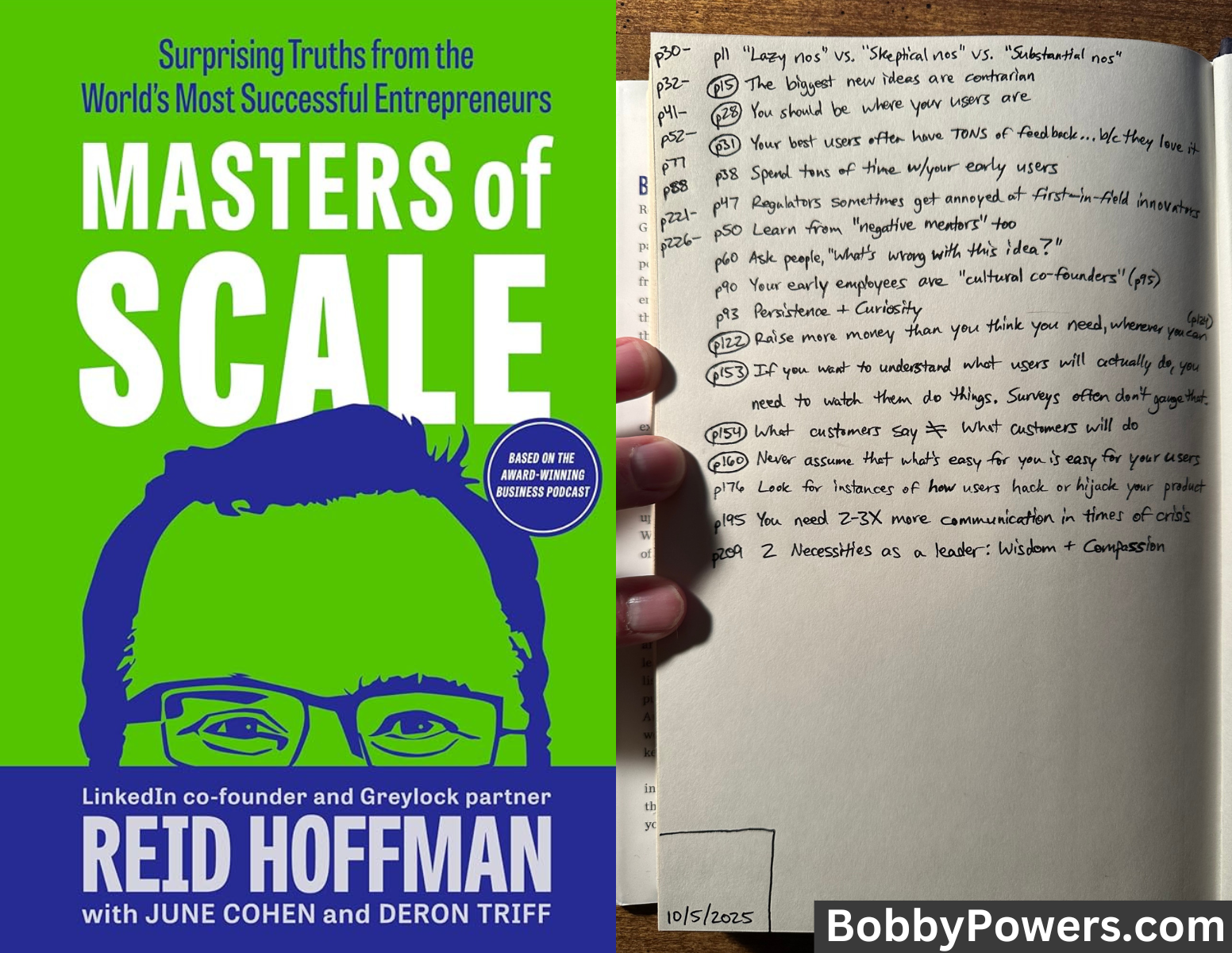
I write in the back cover of every book I read, as shown above.
To learn more about my book notes system, click here.
Book: Masters of Scale by Reid Hoffman with June Cohen & Deron Triff
Reviewer: Bobby Powers
My 3 Biggest Takeaways
- The most profitable ideas are often contrarian.
- "The first truth of entrepreneurship and investing: The biggest new ideas are contrarian. They go so deeply against commonly held assumptions that they seem not only risky but flat-out ridiculous. They're the kind of ideas that draw a lot of 'Nos.'"
- "So if you're pitching a contrarian idea—an idea that questions the status quo, that imagines a different and better way of doing things—brace yourself to withstand and learn from a string of rejections. And when you hear that chorus of 'Nos,' start looking for other signs that you're on to something."
- "When I present an idea to my partners at Greylock, and they all say, 'That's great! We should do that!' my response is: 'Uh-oh.' When you have a group of hyperintelligent, sophisticated investors and no one's saying, 'Watch out for this!'—that's when I know it's too easy. The idea is so obviously good, I can already hear the stampede of competitors trampling over my hopeful little startup. So unanimous consent is always a concerning sign...What I want is for some people to say, 'You're out of your mind,' and some people to say, 'I see it.' I want a polarized reaction."
- Really engaged users tend to have a BUNCH of feedback.
- That's not because they hate your product. It's because they love it, and they're so dialed into what you're trying to build that they have an idea of what your roadmap should be.
- Listen to people like that.
- What users say ≠ What users will actually do
- "Surveys are great when you need to understand nuanced sentiment and feelings. But if you want to understand what you users will actually do, you need to watch them do things."
- "There's often a vast divide between what customers say they want—and what they actually do."
- Example: "Each time Facebook expanded to a new campus, existing users complained. But no one deleted their profiles or abandoned the site; in fact, they used it more than ever.
"One of the things first-time investors don't often realize is in the end it doesn't matter how many 'Nos' you get. The right 'Yes' is the only thing you need." -Reid Hoffman

Selected Quotes & Ideas from the Book
- Reid Hoffman's background
- Cofounder of PayPal and LinkedIn
- Partner at Greylock Partners (VC firm)
- Early investor in Airbnb, Facebook, Zynga, Aurora, and Dropbox
- Host of the Masters of Scale podcast
- "Many of the successful startups in this book began with less than $5,000."
- Kathryn Minshew (cofounder and CEO of The Muse) was turned down by investors 148 times.
- Investors who don't match your user profile (different demographic, background, etc.) often struggle to invest.
- "The earlier you can predict a 'Yes' in a field of 'Nos,' the bigger your opportunity." (The faster you see where the market is going, the more potential money you can make.)
- "Scalable ideas don't have to tackle dramatic problems—they have to tackle neglected problems."
- "While it's true that embracing feedback—and negative feedback in particular—is an essential ingredient in scaling an idea successfully, not all feedback is equal. And sometimes you're better off getting early constructive feedback from outside experts rather than people in your inner circle, who may inadvertently throw cold water on an idea in an effort to protect you from the risk of failure."
- "It's better to have one hundred users who love you than a million users who just kind of like you." -Y Combinator dictum
- "If you look at the companies that have gone on to become most valuable, they tend to have fanatical early users." -Sam Altman
- “Design is not just what it looks like and feels like. Design is how it works.” -Steve Jobs
- "If you hire people at senior positions, you are a failure as a leader." -Barry Diller
- "As a leader, you don't get to do the hands-on work anymore of, say, writing code or designing things. Your job is to point the team in a direction and get everything else out of their way. In order for them to do the best work they can do, you've got to clear the pathway for them." -Eric Schmidt
- "Raise more than you think you need."
- "Take the money whenever and wherever you can get it—because you never know when it will dry up."
Think you’d like this book? Buy it here:
Other books you may enjoy:
- Straight Talk for Startups by Randy Komisar and Jantoon Reigersman
- Shift Ahead by Allen Adamson and Joel Steckel
Other notable books by the author: