Book Summary: “Supercommunicators”
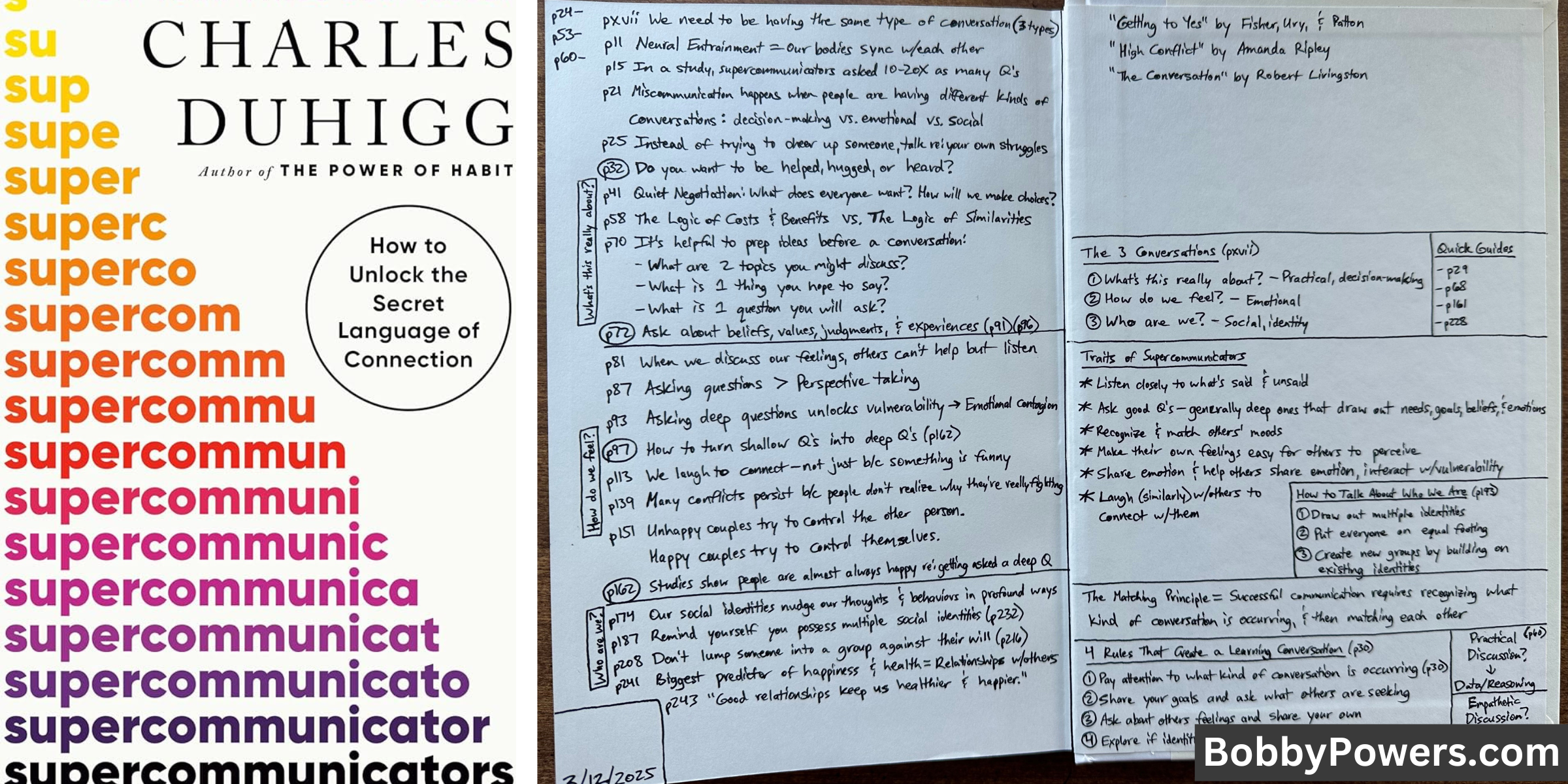
I write in the back cover of every book I read, as shown above.
To learn more about my book notes system, click here.
Book: Supercommunicators by Charles Duhigg
Reviewer: Bobby Powers
My 3 Biggest Takeaways
- Every conversation contains three separate conversations. The best communicators can parse those out and understand which conversation the other person wants to have right now. "However, if we aren't having the same kind of conversation as our partners, at the same moment, we're unlikely to connect with each other."
- What's This Really About? -> Practical info, decision-making
- How Do We Feel? -> Emotional nuance, feelings
- Who Are We? -> Social connection, identity
- Ask "Do you want to be helped, heard, or hugged?"
- I default to giving advice too quickly. Sometimes people just want to be heard.
- Rather than trying to fix everyone else's problems, ask them what they need most from that conversation.
- Asking this question is essentially asking, "What kind of conversation are you looking for?"
- The best way to turn shallow questions into deep questions is to ask about people's needs, goals, beliefs, and emotions. A few examples (shallow -> deep):
- "Where do you live?" -> "What do you like about your neighborhood?"
- "Where do you work?" -> "What was your favorite job?
- "Where did you go to college?" -> "What was the best part of college?"
- "Are you married?" -> "Tell me about your family."
- "Where did you go to high school?" -> "What advice would you give to a high schooler?"
"Effective communication requires recognizing what kind of conversation is occurring, and then matching each other."

Selected Quotes & Ideas from the Book
What Is a "Supercommunicator"?
- Some people "seem to synchronize effortlessly with just about anyone." When they're speaking, they find ways to connect with others in a way that helps each party experience the same feeling of emotion and connection.
- Scientists don't call these people supercommunicators (that's just a colloquialism). They call them terms like "high centrality participant."
- "They were the friends everyone called for advice; the colleagues elected to leadership positions; the coworkers everyone welcomed into a conversation because they made it more fun."
- "High centrality participants tended to ask ten to twenty times as many questions as other participants."
- "But the most important difference between high centrality participants and everyone else was that the high centrality participants were constantly adjusting how they communicated, in order to match their companions. They subtly reflected shifts in other people's moods and attitudes. When someone got serious, they matched that seriousness. When a discussion went light, they were the first to play along. They changed their minds frequently and let themselves be swayed by their groupmates."
Traits of Supercommunicators
- They listen closely to what is said AND unsaid.
- They ask good questions—generally deep ones that draw out needs, goals, beliefs, and emotions.
- They recognize others' moods and try to match them.
- They make their own feelings easy for others to perceive.
- They share emotion and help others share emotion. They interact with vulnerability.
- They laugh similarly with others to better connect with them.
Additional Notes
- "Each of these conversations—and each mindset—is, of course, deeply intertwined. We often use all three during a single dialogue. The important thing to understand is that these mindsets can shift as a conversation unfolds."
- "I learned that if you listen for someone's truth, and you put your truth next to it, you might reach them." -Jim Lawler
- 4 Basic rules in learning conversations:
- 1) Pay attention to what kind of conversation is occurring.
- 2) Share your goals, and ask what others are seeking.
- 3) Ask about others' feelings, and share your own.
- 4) Explore if identities are important to this discussion.
- "If you want the other side to appreciate your interests, begin by demonstrating that you appreciate theirs." -Roger Fisher
- "Stories bypass the brain's instinct to look for reasons to be suspicious." -Emily Falk
- "When we discuss our feelings, something magical happens: Other people can't help but listen to us. And then they start divulging emotions of their own, which causes us to listen closely in return."
- "Questions that asked about everyday experiences or uncontroversial opinions—such as "How did you celebrate last Halloween?" or "What is the best gift you ever received?"—tended to yield answers that were reliably unemotional. In contrast, questions that pushed people to describe their beliefs, values, or meaningful experiences tended to result in emotional replies, even if the questions themselves didn't seem all that emotional. These kinds of questions were powerful because they often prompted people to reveal vulnerabilities."
- "Contrary to our expectations, we found that most conversational laughter is not a response to structured attempts at humor, such as jokes or stories. Less than 20 percent of the laughter in our sample was a response to anything resembling a formal attempt at humor." -Robert Provine (researcher)
- "Rather, people laughed because they wanted to connect with the person they were speaking with."
- "We laugh, in other words, to show someone that we want to connect with them—and our companions laugh back to demonstrate they want to connect with us, as well."
- "In a conflict, we draw out emotions by proving we are listening."
- Researchers have found that happy vs. unhappy couples tend to argue in very different ways, and much of it comes down to the way they try to assert control.
- In arguments, unhappy couples try to control the other person.
- In arguments, happy couples try to control themselves, their environment, and the conflict itself.
- "Asking a deep question should feel like sharing. It should feel, a bit, like we're revealing something about ourselves when we ask a deep question. This feeling might give us pause. But studies show people are nearly always happy to have been asked, and to have answered, a deep question."
- When you're in a conflict with someone, "find specific points of agreement. Look for places where you can say 'I agree with you' or 'I think you're right that...' These remind everyone that, though we may have differences, we want to be aligned."
Think you’d like this book?
Other books you may enjoy:
- You're Not Listening by Kate Murphy
- Crucial Conversations by Patterson, Grenny, McMillan, and Switzler
- Made to Stick by Chip and Dan Heath
Other notable books by the author: