Book Summary: “The Mom Test”
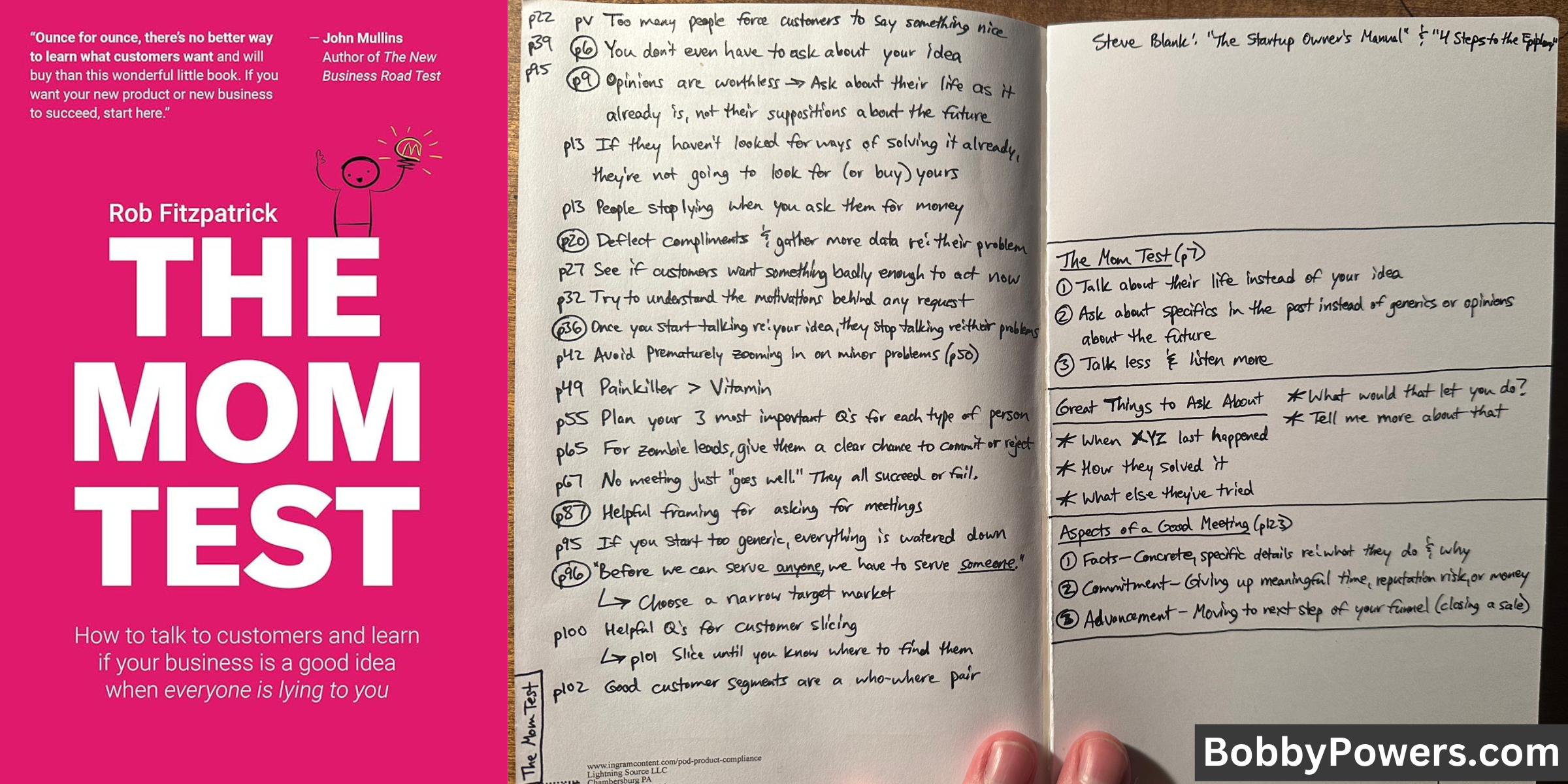
I write in the back cover of every book I read, as shown above.
To learn more about my book notes system, click here.
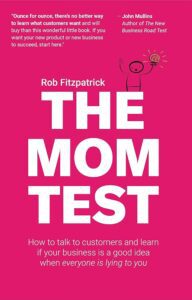
Book: The Mom Test by Rob Fitzpatrick
Reviewer: Bobby Powers
My 3 Biggest Takeaways
This book is a must-read for founders, PMs, UI/UX researchers, and anyone else who's interviewing customers to see if something is a good idea.
Fitzpatrick calls his customer interview strategy The Mom Test because it "leads to questions that even your mom can't lie to you about."
It whittles down to 3 simple rules:
 Talk about the customer's life instead of your idea.
- One of the most effective ways to gather useful customer feedback is to ask questions about the person and their life without telling them about your idea.
- Seriously, don't even tell them. This helps you avoid biasing the customer, who would be inclined to give you vague compliments or say things they think you want to hear.
 Ask about specifics in the past instead of generics or opinions about the future.
 Example Bad Questions
- "Do you think it's a good idea?"
- "Would you buy a product which did X?"
- "How much would you pay for X?"
 Example Good Questions
- "Talk me through the last time that happened."
- "What are the implications of that?"
- "What else have you tried?"
- "How are you dealing with it now?"
 Talk less and listen more.
- "You can tell it's an important question when its answer could completely change (or disprove) your business."
- "Every time you talk to someone, you should be asking at least one question which has the potential to destroy your currently imagined business."
"Trying to learn from customer conversations is like excavating a delicate archaeological site. The truth is down there somewhere, but it's fragile. While each blow with your shovel gets you closer to the truth, you're liable to smash it into a million little pieces if you use too blunt an instrument.
I see a lot of teams using a bulldozer and crate of dynamite for their excavation. They are, in one way or another, forcing people to say something nice about their business. They use heavy-handed questions like 'do you think it's a good idea' and shatter their prize."

Selected Quotes & Ideas from the Book
- "We want to find the truth of how to make our business succeed. We need to dig for it—and dig deep—but every question we ask carries the very real possibility of biasing the person we're talking to and rendering the whole exercise pointless. It happens more than you'd ever imagine."
- "Bad customer conversations aren't just useless. Worse, they convince you that you're on the right path. They give you a false positive that causes you to over-invest your cash, your time, and your team."
- "If they haven't looked for ways of solving it already, they're not going to look for (or buy) yours."
- "It boils down to this: you aren't allowed to tell them what their problem is, and in return, they aren't allowed to tell you what to build. They own the problem, you own the solution."
- "Compliments are the fool's gold of customer learning: shiny, distracting, and worthless."
- Deflect compliments. Ignore them and gather more information about their problem.
- "You're not here to collect compliments; you're trying to learn the truth."
- Identify the type of risk that is most likely to trip up your business, then ask about that risk.
- 2 Types of risk:
- Product Risk: Can I build it? Can I grow it?
- Customer/Market Risk: Do they want it? Will they pay me? Are there lots of them?
- "It took me years to learn that there's no such thing as a meeting which just 'went well'. Every meeting either succeeds or fails...A meeting has succeeded when it ends with a commitment to advance to the next step. But you have to force this resolution or the meetings drift along in la-la-land while performing their ancient duty: wasting everyone's time."
- Start with a narrow target market
- "They say that startups don't starve, they drown. You never have too few options, too few leads, or too few ideas; you have too many. You get overwhelmed. You do a little bit of everything. When it comes to getting above water and making faster progress, good customer segmentation is your best friend."
- "If you start too generic, everything is watered down. Your marketing message is generic. You suffer feature creep."
- "Before we can serve everyone, we have to serve someone."
- "When we're in the moment, choosing a really specific customer segment just feels like we're losing all the other options. And that loss is painful. Remind yourself that you'll get to the whole world eventually. But you've got to start somewhere specific."
- Good questions to wrap up:
- "Who else should I talk to?"
- "Is there anything else I should have asked?"
Think you’d like this book? Buy it here:
Other books you may enjoy:
- Straight Talk for Startups by Randy Komisar and Jantoon Reigersman
- Million Dollar Weekend by Noah Kagan
Other notable books by the author: