Book Summary: “Tiny Experiments”
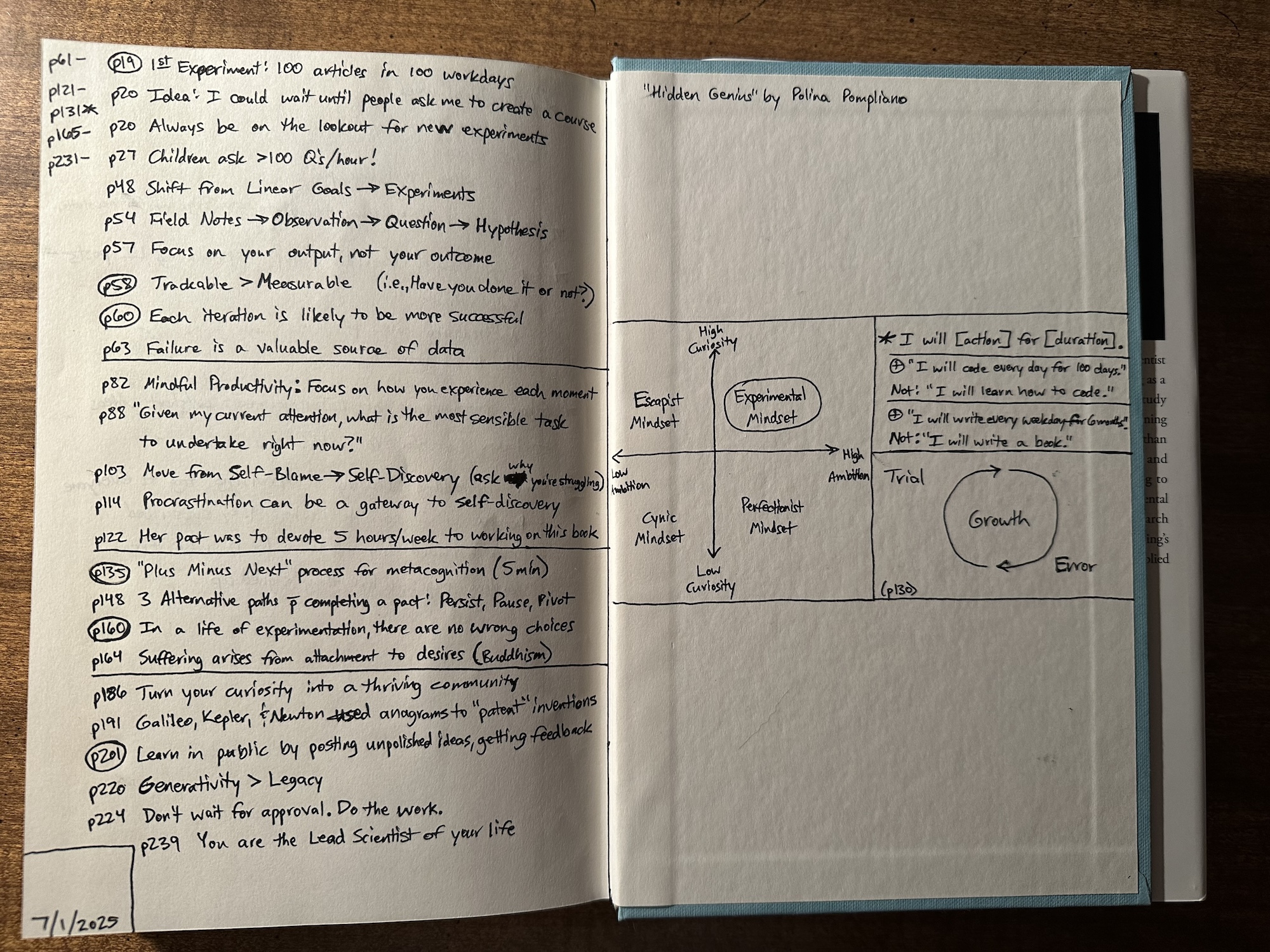
I write in the back cover of every book I read, as shown above.
To learn more about my book notes system, click here.
Book: Tiny Experiments by Anne-Laure Le Cunff
Reviewer: Bobby Powers
My 3 Biggest Takeaways
- Society is obsessed with setting linear goals, but those types of goals often don't work because they imply we know the right path we should take. Nearly 100% of the time, we don't know what we don't know. Linear goals also make us feel like we're constantly failing to live up to some idea of where we should be, what we need to accomplish, and what we need to do by when.
- Rather than setting linear goals, we should run constant micro-experiments. If you’re unsure whether something will work, find a way to test your hypothesis for a specific period of time. Then tweak. Then test. Then tweak. Then test again. Run hundreds of small experiments like this every year. Do more of whatever works and stop anything that doesn’t. (This is especially helpful online: social media, digital ads, etc.)
- "The final step is to turn your hypothesis into a pact—an actionable commitment you will fulfill for a set period of time...It follows a simple format: I will [action] for [duration]."
- Bad Pact: "I will write a book."
- Good Pact: "I will write every weekday for the next six months."
- "It's almost impossible to fail when you see everything as an experiment. In a life of experimentation, there is no wrong choice, either. A pact (something you commit to try for X amount of time) isn't a destination. It's a path you walk to discover more about yourself and the world."
"For sustainable success, we need to pause to learn from each repetition; to make small adjustments each time, picking up new abilities and knowledge along the way. When we use trial and error, we set in motion a series of growth loops where progress emerges in conversation with our environment...We don't go in circles; we grow in circles." -Anne-Laure Le Cunff

Selected Quotes & Ideas from the Book
- "I love writing, so I made a pact with myself to write and share 100 articles in 100 workdays, drawing on my university studies and personal readings...I finished the 100 articles and decided to keep going. My newsletter grew steadily to one hundred thousand readers. I called in Ness Labs, a combination of the suffix -ness, which describes the quality of being (which you find in words such as awareness, consciousness, mindfulness, and labs, as I wanted it to be a laboratory for personal experimentation."
- "Uncertainty has so much to teach us."
- "Children collect and connect information by constantly scouting their environment. They try activities beyond their capabilities, they attempt to predict the effects of their actions, and they keep asking 'Why?'—in fact, children ask more than a hundred questions per hour on average. By failing fast and often, they learn from every experience to propel themselves forward. Children are insatiable adventurers."
- We spend most of our lives trying to live up to a fantastical idea of what success looks like. These success narratives take the form of several predictable cognitive scripts:
- The Sequel Script: When we follow our past -> We try to stay consistent with our past behaviors and sense of self (continuation bias, path dependence, fatalism, self-consistency fallacy)
- The Crowdpleaser Script: When we follow the crowd -> Taking on a profession just because family members, friends, or society views it as important (doctor, lawyer, Stanford MBA, job at Google, etc.)
- The Epic Script: When we follow our passion -> "A deceptive 'ideal' path that is contrived around some imagined destination that is far from where we currently stand. This is yet another linear goal, focused more on the target than on the journey."
- "The popularity of the Epic script is largely due to survivorship bias, when we mistake a successful subgroup as the entire group, overlooking those who failed."
- "The beauty of shifting from linear goals to experiments is that you don't have to force your decisions to fit into any notion of who you thought you were or wanted to be. You are allowed to go off script. You can have multiple passions. You can make progress without a fixed purpose."
- Good questions to ask yourself:
- Are you following your past or discovering your path?
- Are you following the crowd or discovering your tribe?
- Just like an anthropologist, jot down field notes of what you observe about your life.
- Journal about how your energy and mood shifts throughout the course of a day or week based on the activities you tackle and the encounters you have with other people.
- "When you take a step back to consider a typical day of your life, do you feel like anything is missing? Do you feel a yearning toward something different?"
- "Like a scientist, you can now use your observations to formulate a hypothesis. It all starts with a research question. For example, if you observe that you're feeling energized when discussing certain topics, you might ask yourself: How can I incorporate more of this into my daily life? Then turn this question into a hypothesis."
- "The final step is to turn your hypothesis into a pact—an actionable commitment you will fulfill for a set period of time...It follows a simple format: I will [action] for [duration]."
- "What makes a pact so effective is that it focuses on your outputs (e.g., 'publish 25 newsletters over the next 25 weeks') rather than your outcomes (e.g., 'get 5,000 newsletter subscribers in 25 weeks'). It gives you the confidence to get started because there is not bad result or wrong choice. You just need to show up."
- Your pact should be purposeful, actionable, continuous, and trackable. (Note: Trackable > Measurable. Trackable is binary: did you do it or not?)
- "'I will learn how to code' is a flawed pact, but 'I will code every day for a hundred days' is a great one. Instead of 'I will write a book,' try 'I will write every weekday for the next six months.' Replace 'I will run a marathon' with 'I will run every Sunday for six weeks.'"
- "The format of the pact provides a simple mechanism to commit to action, a way to rely on momentum instead of motivation."
- "The repeated trials of your pact provide you with more reliable information to make decisions. Furthermore, each iteration is likely to be more successful..."
- "The more you do, the more you fail. The more you fail, the more you learn. The more you learn, the better you get." -John Maxwell
- Helpful question to ask yourself when having a low-energy day: "Given my current attention and working memory, what is the most sensible task to undertake right now?"
- When we procrastinate, we're usually doing it for a reason. Sometimes it's actually a really good reason, like that we haven't figured out something yet and we shouldn't move forward before unlocking that core question.
- "A lot of the pain we experience when we procrastinate stems from viewing it as an enemy to fight against and overcome, instead of a partner to understand and collaborate with. The problem with procrastination is not that you've been lazy. The problem is that you shot the messenger."
- "Maybe you're putting off writing a report because you're concerned it won't be perfect. Maybe you're avoiding a project because you don't know where to start or because it doesn't excite you."
- "Rather than being an indication of laziness or lack of discipline, procrastination points to nuanced psychological roadblocks that need addressing."
- "In contrast to this sterile self-judgment, we might instead ask ourselves a potentially fertile question: Why are you procrastinating?"
- "For an entire year, my pact was to devote at least five hours per week to working on this book. It often ended up being many more hours, but I designed it this way because it was more flexible than a daily pact (e.g., 'one hour per day') and allowed me to shift things around in my schedule if needed."
- Helpful self-reflection tool: Plus Minus Next
- Plus: Positive observations from your day/week, what went well, accomplishments that made you proud, moments that brought you joy, etc.
- Minus: Negative observations, challenges, struggles, missed opportunities, etc.
- Next: Your ideas on how to improve, what to do from here, use the Plus and Minus columns to inform your plans for what to try next
- "Completing a pact doesn't mean you must now strive for more. Instead, you're at a crossroads, where different paths are available. All things considered, there are three viable alternative routes for this transition:"
- Persist: Keep doing the thing
- Pause: Put that activity on hold for now
- Pivot: Tweak something in your experiment
- "Life isn't about waiting for the storm to pass. It's about learning to dance in the rain." -Vivian Greene
- "Buddhism teaches that suffering arises from attachment to desires, including the desire for control over outcomes."
- "Anyone can turn their curiosity into a thriving community. You don't have to be a savant or even particularly charismatic. You just need to assemble a circle of fellow curious minds who would like to explore similar ideas together. What I like to call a curiosity circle is a community centered around genuine connection and peer learning."
- Learn in public
- "By nature, experiments are imperfect. They can also be a bit scary. However, iterating in public creates a culture of learning around yourself. A scholar might blog about their research to get real-time feedback from peers. A startup founder might build a scrappy version of their product to gauge demand. A designer could publish rough sketches. In each case, putting forward unpolished ideas sparks an ongoing dialogue, to reveal any gaps and iterate rapidly."
- "Learning in public is the opposite of pretending you have everything figured out. Instead, share your real work in real time—the raw stuff, not the highlights reel."
- "Share even the lessons from an experiment that failed."
- "Find opportunities to document and share that align with work you would be doing anyway. For instance, writers and artists share snippets of works in progress, giving fans a peek while maintaining momentum...With this integrated approach, learning in public becomes part of your workflow."
- "There is no need to be afraid of starting a public platform as long as you show the world that you are ready to be proven wrong when presented with new evidence. Be ready to say: I got it wrong, now we can learn together." -Kristyn Sommer
- "Instead of waiting for someone to sign off on your competence, build your experience by turning your interests into action, focusing on how you can create value for others. Designer Jack Butcher calls this a 'permissionless apprenticeship,' Seth Godin talks of the practice of 'shipping' work, Cal Newport refers to the 'craftsman mindset'—whatever you decide to call it, don't wait for approval; do the work first."
- "I am successful on my own terms. Because if your success is not on your own terms, if it looks good to the world but does not feel good in your heart, it is not success at all." -Anna Quindlen
- "It is much easier to be fired for being illogical than it is for being unimaginative. The fatal issue is that logic always gets you to exactly the same place as your competitors." -Rory Sutherland
- "Remember that you are the lead scientist of your life. There is no universal formula. You are unique and nothing about your future is fixed. Whether you are twenty or seventy, you can move in any direction your curiosity leads...Success is the lifelong experiment of discovering what makes you feel most alive."
Think you’d like this book? Buy it below.
Other books you may enjoy:

Hi Bobby. Nick here from Substack, we chatted the other day when commented on one of your Notes.
I just had a read, finnsly, of this summary, and I thought I was excellent. I loved the 3 main takeaways at the top.
I was just wondering, in thr actual book does the author mention how she manages to conduct hundreds of experiments? I do a similar thing, I try to conduct as many experiments as possible to figure things out, but I’d love to know if she has a particular way of administer that, as it’s very easy to say, perform hundreds of experiments, but a lot harder to do and manage.
I find a lot of book fall down in this regard, as they fail to explain the logistics of actioning their own advice. I’d love to know as I’d read the book if it does.
Currently I simply treat many of my tasks as experiments. If it’s got, “explore” or “research” or “look into” then it’s treated as an experiment, I write a basic hypothesis to keep things agile etc.
anyway, thanks again for the fantastic summary. And thanks again for connecting on Substack.
Have a great week, and hopefully I shall catch you again on there soon.
Hi Nick! Yes, I definitely remember you. Thanks for popping over to check out my website. That means a lot! 🙂
The idea of “hundreds” of experiments is mostly from me—not from the author. I don’t remember her giving any kind of number like that, but that’s just the way I internalized her message: that we should be constantly running experiments to see what works and what doesn’t.
Overall, I thought Le Cunff did a pretty good job of explaining how she runs experiments in her own life. The most poignant example is how she began writing online: she decided to write every weekday for 100 days, and she talks about when in the day she did that, what her goals were, how she decided whether to continue, stop, or pivot that initiative when the 100 days were up, etc.
I agree that the failure of some nonfiction books is that the author doesn’t make them practical enough. But my subjective take on this one is that she did a solid job of that. I left with a bunch of ideas of how I could immediately enact her principles in my own life.
In case it’s helpful, here’s the experiment template I created for myself after reading Le Cunff’s book. I use Obsidian for note-taking, so I created an Obsidian template that I use to track this info for each experiment I run:
– Date:
– Current State: (Of whatever I’m experimenting on)
– Problem I’m trying to solve:
– Experiment: (What I’m going to try)
– Length of Time I Will Test This:
– Hypothesis:
– Actual Outcome:
– Lesson(s) Learned: