Book Summary: “Working Backwards”
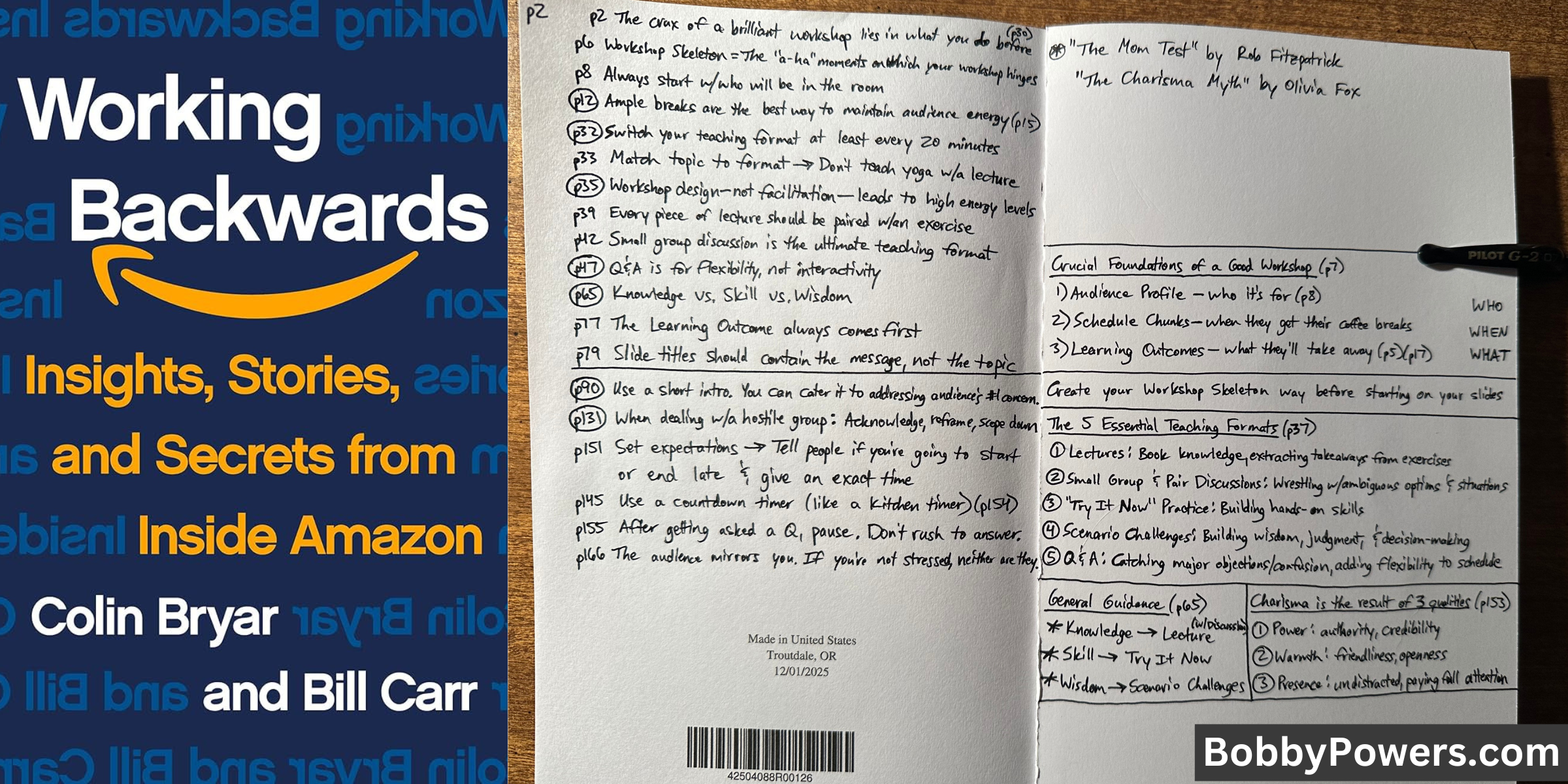
I write in the back cover of every book I read, as shown above.
To learn more about my book notes system, click here.
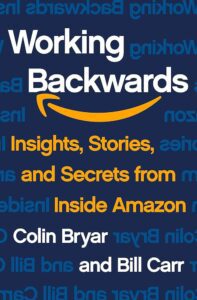
Book: Working Backwards by Colin Bryar and Bill Carr
Reviewer: Bobby Powers
My 3 Biggest Takeaways
 Relentlessly focus on what your customers need (and want)
- "Our culture is four things: customer obsession instead of competitor obsession, willingness to think long term, with a longer investment horizon than most of our peers, eagerness to invent, which of course goes hand in hand with failure; and then, finally, taking professional pride in operational excellence." -Jeff Bezos
 Writing > Presenting
- PowerPoints are banned at Amazon. Employees must write 6-page narratives instead.
- The start of each meeting is reserved for attendees silently reading the narrative.
- "The reason writing a good 4 page memo is harder than 'writing' a 20 page powerpoint is because the narrative structure of a good memo forces better thought and better understanding of what's more important than what, and how things are related. Powerpoint-style presentations somehow give permission to gloss over ideas, flatten out any sense of relative importance, and ignore the interconnectedness of ideas."
 Launch products with Single-Threaded Leaders
- "A single person, unencumbered by competing responsibilities, owns a single major initiative and heads up a separable, largely autonomous team to deliver its goals."
- "The basic premise is, for each initiative or project, there is a single leader whose focus is that project and that project alone, and that leader oversees teams of people whose attention is similarly focused on that one project."
"We have an unshakeable conviction that the long-term interests of shareowners are perfectly aligned with the interests of customers." -Jeff Bezos

Selected Quotes & Ideas from the Book
- The authors spent a total of 27 years at Amazon.
- Colin was Jeff Bezos's technical advisor (essentially a chief of staff), which is informally referred to as "Jeff's shadow."
- Bill led Amazon's worldwide digital music and video business and engineering organizations.
- "We need to plant many seeds because we don't know which one of those seeds will grow into a mighty oak." -Jeff Bezos
- "If a company's principles must be memorized, it's a warning sign that they aren't sufficiently woven into the fabric of the company. We know and remember Amazon's principles because they are the basic framework used for making decisions and taking action."
- "As we do new things, we accept that we may be misunderstood for long periods of time." -Amazon Leadership Principles
- "There is no substitute for working long, hard, and smart at Amazon."
- Good questions to ask reference checks (about a job candidate):
- "If given the chance, would you hire this person again?"
- "Of the people you have managed or worked with, in what percentile would you place this candidate?"
- "In my tenure at Amazon I heard [Jeff] say many times that if we wanted Amazon to be a place where builders can build, we needed to eliminate communication, not encourage it. When you view effective communication across groups as a 'defect,' the solutions to your problems start to look quite different from traditional ones."
- "Amazon's approach to morale was to attract world-class talent and create an environment in which they had maximum latitude to invent and build things to delight customers."
- "Most decisions should probably be made with somewhere around 70% of the information you wish you had. If you wait for 90%, in most cases, you're probably being slow. Plus, either way, you need to be good at quickly recognizing and correcting bad decisions. If you're good at course correcting, being wrong may be less costly than you think, whereas being slow is going to be expensive for sure." -Jeff Bezos
- "The best way to fail at inventing something is by making it somebody's part-time job." -Dave Limp, Amazon's SVP of Devices
- "Be stubborn on the vision but flexible on the details."
- More info on 6-Page Narratives
- "Amazon relies far more on the written word to develop and communicate ideas than most companies, and this difference makes for a huge competitive advantage."
- "Gradually, we settled on a standard format. Maximum length: six pages, no desperate tricks in formatting please. Appendices with further information or supporting detail could be attached, but would not be required reading in the meeting itself."
- "It should go without saying—sound decisions draw from ideas, not individual performance skills...It won't matter whether the presenter is a great salesperson, a complete introvert, a new hire out of college, or a VP with 20 years of experience; what matters will be found on the page."
- "The narrative document is infinitely portable and scalable. It is easy to circulate. Anyone can read it at any time."
- "Six-page narratives are also incredibly inclusive communication, precisely because the interaction between the presenter and the audience is zero during reading. No biases matter other than the clarity of reasoning."
- Amazon often works backwards through a PR/FAQ process: "writing a press release that literally announces the product as if it were ready to launch and an FAQ anticipating the tough questions."
- "The press release (PR) portion is a few paragraphs, always less than one page. The frequently asked questions (FAQ) should be five pages or less."
- Focus on controllable input metrics, not output metrics.
- "The right input metrics get the entire organization focused on the things that matter most. Finding exactly the right one is an iterative process that needs to happen with every input metric."
- "Often the data you want will be scattered across different systems and may take some serious software resources to compile, aggregate, and display correctly. Do not compromise here. Make the investment. If you don't, you may find that you are flying blind with respect ot some important aspect of the business."
- The Andon Cord = Idea from Toyota. "When any worker notices a quality problem, they are authorized to pull a cord that stops the entire assembly line."
- "Some decisions are consequential and irreversible or nearly irreversible—one-way doors—and these decisions must be made methodically, carefully, slowly, with great deliberation and consultation. If you walk through and don't like what you see on the other side, you can't get back to where you were before. We can call these Type 1 decisions. But most decisions aren't like that—they are changeable, reversible—they're two-way doors. If you've made a suboptimal Type 2 decision, you don't have to live with the consequences for that long. You can reopen the door and go back through. Type 2 decisions can and should be made quickly by high judgment individuals or small groups." -Jeff Bezos
- When Amazon was developing the Kindle device, "Jeff stayed so deeply involved in the project that he was unofficially known as the chief product manager for Kindle."
- "In mid-October 2004, several senior Amazon executives received an email from Jeff Bezos that read roughly as follows: 'We should not be satisfied with the growth of our retail business. This is a house-on-fire issue and we need to dramatically improve the customer experience around shipping. We need a shipping membership program. Let's build and launch it by the end of the year." -> This led to the creation of Amazon Prime.
- "Most retail CEOs walk the store when they have a chance, and Jeff is no exception. The typical CEO will pay a visit to a retail outlet when they're in the area—often unannounced, or even incognito—to do a bit of browsing and observe what's going on. An online retail CEO can walk the store anytime, of course, and Jeff's preferred walking-the-store time was early Saturday and Sunday mornings. It was not unusual for me to wake up at 7 a.m. on a weekend, check my email, and read five or six messages from Jeff to the relevant teams on issues he had found while walking the store that morning."
Think you’d like this book? Buy it here:
Other books you may enjoy: