Book Summary: “The Workshop Survival Guide”
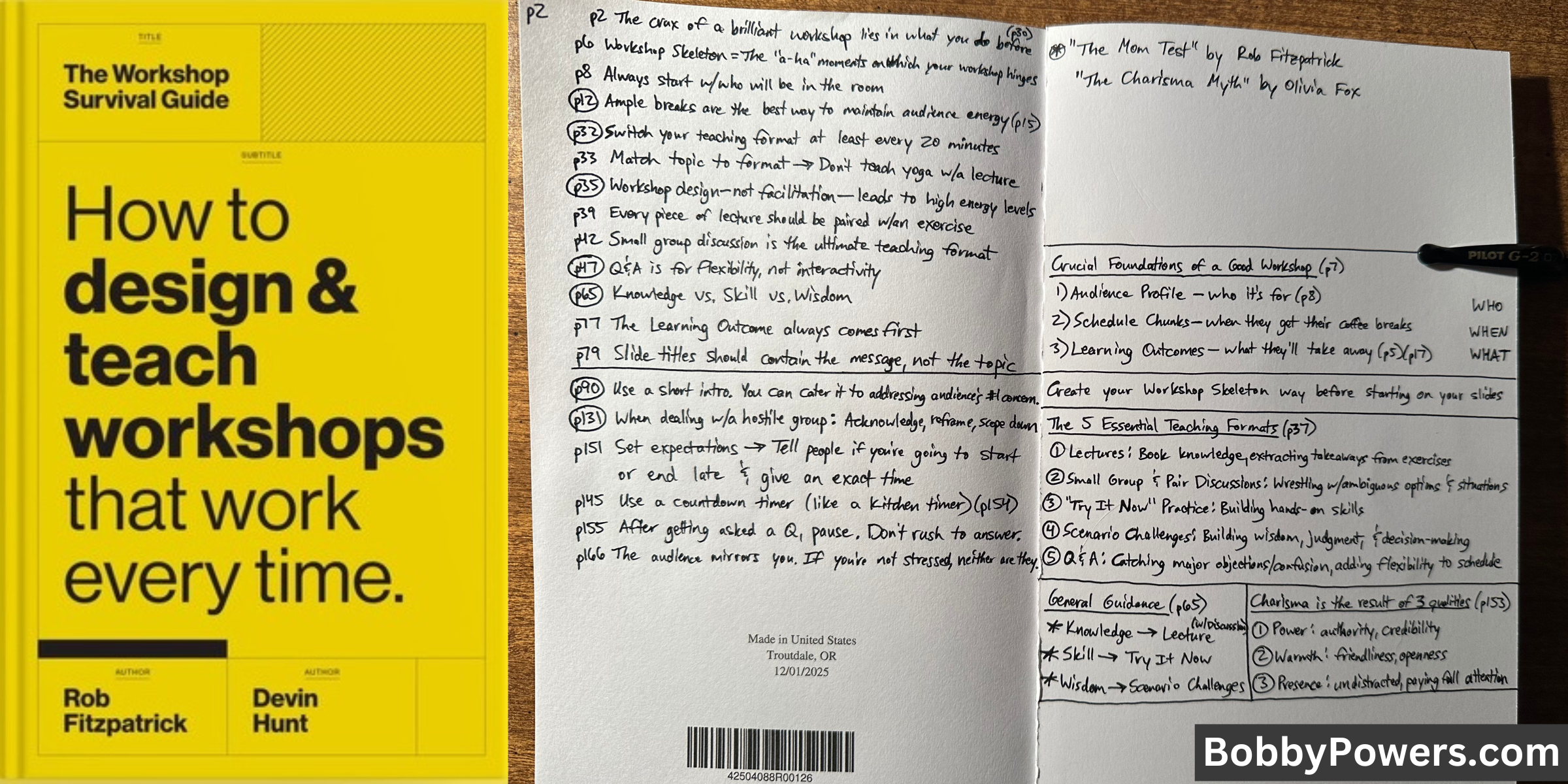
I write in the back cover of every book I read, as shown above.
To learn more about my book notes system, click here.
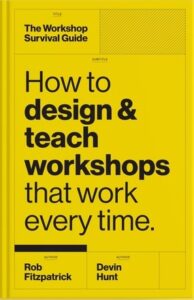
Book: The Workshop Survival Guide by Rob Fitzpatrick and Devin Hunt
Reviewer: Bobby Powers
My 3 Biggest Takeaways
 "The crux of a brilliant workshop lies in what you do beforehand. When a workshop is well-designed, it does most of the heavy lifting for you, and facilitation becomes naturally easy."
- Plan enough breaks. In fact, in your schedule, "Add the breaks before designing the content."
- Having enough breaks is the number one thing you can do to maintain audience energy.
 The majority of workshop design is knowing when to use the 5 Essential Teaching Formats, then varying those formats throughout your workshop:
- Lectures -> For delivering "book knowledge" and extracting takeaways from exercises
- Small Group and Pair Discussions -> For wrestling with ambiguous options and personal implications
- "Try It Now" Practice -> For building hands-on skills
- Scenario Challenges -> For building wisdom, evaluation, judgment, and decision-making
- Question & Answer -> For catching major objections/confusion and adding some flexibility into your schedule
 Small group discussion is often the most powerful teaching format.
- "Let's go out on a limb here: small group discussion is the ultimate Teaching Format. When used properly, it's engaging, inclusive, widely applicable, encourages debate, is easy to run, and lets attendees get to know each other in an educational and non-awkward way."
- "It's so easy and so reliable that it nearly feels like cheating. That being said, almost everybody screws it up."
- You need to plan exactly which questions/prompts you'll use. Thoughtfully choose ones with the appropriate level of difficulty.
"Every workshop lives or dies by two factors: (1) What the audience learns and (2) How the audience feels (i.e. energy and attention)." -Rob Fitzpatrick & Devin Hunt

Selected Quotes & Ideas from the Book
- Crucial foundations of a good workshop:
- WHO: Audience Profile - who it's for
- WHEN: Schedule Chunks - when they get their coffee breaks
- WHAT: Learning Outcomes - what they'll take away
- Plan enough breaks
- "By working to boost their energy, you'll also boost their ability to pay attention, which ultimately makes it easier for them to learn."
- "If your workshop is longer than about 90 minutes, then the breaks are really, really important. In fact, nothing will maintain your audience's energy as effectively as just inserting an ample break (i.e. 15 minutes for coffee, 60 minutes for lunch) after every 60-90 minutes of content."
- "Coffee breaks are sacred. It's a big blunder to skip (or even just reduce) a break in order to cram in more stuff. In one fell swoop, the break-skipping facilitator manages to damage energy levels, violate the schedule, and diminish the audience's ability to pay attention. Unforgivable!"
- Sample ideal schedule:
- 9:00-9:15am - Time for everyone to get settled in
- 9:15-10:45am - Session #1 (90 min)
- 10:45-11am - Break
- 11am-12:30pm - Session #2 (90 min)
- 12:30-1:30pm - Lunch
- 1:30-3pm - Session #3 (90 min)
- 3-3:15pm - Break
- 3:15-4:45pm - Session #4 (90 min)
- 4:45-5pm - Wrap up
- "Having extra time is rarely a problem: just run more exercises or take more questions. But having too little time (and too many Learning Outcomes) very well might be."
- Know when to use various types of exercises. It all depends on whether you're trying to teach Knowledge vs. Skill vs. Wisdom:
- Knowledge -> Taught by lecture and buttressed by small group discussion
- Skill -> Taught by "Try it now" exercises
- Wisdom -> Taught by scenario challenges
- Lectures
- "Lectures work fine for delivering pure 'book knowledge', but are terrible for teaching anything involving skills, wisdom, evaluation, practice, decision-making, and judgment."
- "Lectures become bad when they overstay their welcome, running uninterrupted for too long (i.e. more than 15-20 minutes) and when they attempt to teach topics and takeaways fro which they are poorly-suited."
- "If you have a tendency toward lecture, then here's a rule of thumb to greatly improve your workshops: Every piece of lecture should be paired with an exercise which attacks the same topic from a more interactive direction."
- Small Group and Pair Discussions
- "Asking your students to, 'Turn to your neighbor and discuss' seems harmless but is actually impossibly vague."
- "Instead, you need to instruct your participants—explicitly and specifically—what they're supposed to be talking about. And just saying it out loud isn't enough, because they'll inevitably forget and go off track. You need to write it somewhere visible (usually a slide) and leave it there for the duration of the exercise."
- "If you feel the discussion topic is so large that folks will need more than five minutes to get into it, then it's probably too vague and should be broken into pieces."
- Question and Answer
- "Q&A is for flexibility, not interactivity."
- "Unstructured Q&A is a bad educational format. Even when used properly, Q&A suffers from an irredeemable flaw: the least confident students will never speak up."
- "Q&A's most gratuitous abuse is as a way to pretend that a long, dreary lecture is actually a fun, 'interactive' discussion."
- "Q&A's primary purpose is to be deleted when you're running late. This Format's greatest value lies in the fact that it is a credible—but not essential—way to fill an ambiguous amount of time. And it's flexible."
- "You can include Q&A as a flexible 'schedule spring' which can stretch and shrink to soak up changes in the timing elsewhere. The inclusion of these springs is the secret to finishing exactly on time, even if you're starting late or running behind."
- "Springs are a useful general design concept, and I recommend including at least 15 minutes of spring in every 90-minute chunk of your schedule."
- Great question: "When you go home and try to put this into practice, what are you most worried about not being able to do?"
- "Try It Now" Exercises
- "'Try it now' is both incredibly powerful and tragically underused. The idea is simple. After introducing any concept which is even slightly skill-based, give the students a small task which allows them to immediately put it into practice in a safe, controlled environment, and under enough supportive restrictions that they can't get too far off track."
- Scenario Challenges
- "In a 'try it now', you tell everyone what they need to do. In a scenario challenge, you ask them to figure out what they ought to do. The former builds skill; the latter, judgment."
- "Although good scenario challenges can take a bit of preparation to design, they're infinitely reusable once you've made them."
- "And despite being largely hands-off to facilitate, good challenges are extremely high-energy and fun for attendees."
- Including lots of variation between different teaching formats will help your audience maintain a high energy level.
- Slide titles should contain the message, not the topic. For example, the title should be something like "Sales is about asking good questions" instead of "Sales 101."
- If you find that your audience is hostile or skeptical of you, acknowledge what they're thinking.
- Simply saying out loud what they're already thinking can win over a big chunk of the audience.
- "Incidentally, this is also how I position myself when I'm brought in to teach a crowd of experts who are more successful, powerful, rich, and generally better at life than me. The general pattern is to acknowledge, reframe, and scope down:
- Acknowledge: 'You guys are obviously miles ahead of me in your lives/careers/businesses and have a ton of stuff going on that I wouldn't even know where to start with..."
- Reframe: '...So I'm not here to try to solve all your problems or to tell you what to do."
- Scope down to an area where you can add clear value: "But I've been obsessing over the question of X, and I'm hoping that if you'll let me share the theory/skills/thinking/examples/etc., that you'll be able to find a couple useful tools to bring back to your own worlds.'"
- If you're running over on time and plan to run late, tell the audience. "The most important thing is to tell them, in advance, about the change in plans. People get extremely jittery if you're still in the middle of teaching as the clock is approaching the end of the workshop."
- "Charisma" is the result of projecting three qualities (from The Charisma Myth by Olivia Fox)
- Power: Authority, credibility
- Warmth: Friendliness, openness
- Presence: The audience feels like you are undistracted and paying full attention to them
- Don't rush to answer audience questions before they've finished asking the question. That comes across as defensive or jumpy. "Better, instead, to let them finish saying whatever they are going to say, pause for an additional moment or two (this beat of silence is powerful), and then respond."
- "The golden rule of workshop disasters is this: the audience mirrors your panic. If you're cool with it, they're cool with it. Shrug it off, adjust the plan, and keep on keeping on."
- If you get a low turnout for your workshop, focus on serving the people in the room, even if there aren't many of them. "Focus on those who are there, not those who aren't. Remind your attendees—and yourself, if needed—that this is great news, because you'll really be able to get into it together. Treat the small group as a rare opportunity to gather deep insight into what your audience cares about, which will pay dividends for all future workshops."
Think you’d like this book? Buy it here:
Other books you may enjoy:
Other notable books by the authors: