Performance Management: A Step-by-Step Guide for Managers

The first time I had to fire someone was fifteen years ago. It went so poorly that he almost jumped over the table at me, and our company’s security guards had to drag him out of the building. (True story.)
Thankfully, that’s the roughest termination I’ve ever dealt with, and if you do a good job of developing your team and candidly sharing feedback when they go off-track, you can avoid most terminations entirely.
The purpose of this article is to provide some best practices around what good management looks like when a team member is performing poorly.
Most of the time, if you have the courage to share difficult feedback early and often with a struggling employee, they’ll be able to turn things around before it’s too late, which is a win-win for everyone.
Let’s Look at a Real-World Situation
Most articles about performance management are way too theoretical: they don’t tell you what to actually do and say during each step. To avoid that, I’ve tried to make this post as practical as possible.
We’ll walk through each aspect of performance management using a realistic situation that’s very similar to many examples I’ve encountered in the past decade while leading teams and training managers. Even if you work in a different industry than this example, you can apply the same principles and much of the same language.
Here’s the situation:
- You work in customer service.
- You’re a new manager, and your direct report Tommy is struggling.
- Tommy is a great guy. Everybody loves him. But unfortunately, Tommy has been completing many client tasks late, and he frequently drops the ball in a way that negatively impacts clients and colleagues.
- You know Tommy’s last manager talked to him a bit about this issue, but the problem persists. Now you want to dive into it because it’s causing issues.
For each performance management step below, you’ll notice one of these callout sections. They’ll connect the performance management principles back to this realistic situation with Tommy. That way, you’ll get to see what each concept looks and feels like in practice.
3 Fundamental Truths
When managing a struggling employee, it’s important to accept these three things:
- No one wants to do a bad job. Sometimes, people lose focus or motivation, but that doesn’t mean they’re a bad person or that they’re actively trying to do a poor job.
- Sometimes an employee is a great fit in one company and a bad fit in another. Performance is a function of how closely someone’s skills and behavior match the specific job tasks, culture, manager, company, etc. Everyone wants to find a place where they can be their best self as a happy, productive, and successful worker. Just because someone’s not successful in one job doesn’t mean they won’t be successful somewhere else.
- The best way to help someone be successful is to share feedback early and often. If you don’t give them feedback, they won’t grow and they won’t be able to address their weaknesses.
As Brené Brown says, “Clear is kind. Unclear is unkind.”
The Performance Management Process
There are many ways to work with poor performers to help them turn a corner, but here’s a helpful 6-step process to follow:
- Observe & Investigate: See who’s doing well and who’s struggling on the team
- Give Feedback: In every 1-on-1, give feedback about what’s going well and not going well
- Stay Close: For employees who are struggling, watch their work more closely
- Ramp Up Feedback: If the employee keeps making the same mistakes, provide more serious feedback. Give them a chance to improve.
- Give a Warning: If the issue is serious enough, let them know that if the behavior doesn’t improve, they’ll lose their job (yes, it’s important to actually say this)
- If the Situation Doesn’t Improve, Let the Employee Go: Partner with HR to terminate the employee and hopefully help them find a job that’s the right fit
Every company’s process and culture is a bit different, so be sure to partner with your HR team throughout this process. They may have a slightly different way of doing things, and they can also share any local laws and regulations you’ll need to consider.
Below, we’ll break down each step into further details.
Step 1: Observe & Investigate
Every employee has strengths and weaknesses. As you manage your team, pay attention to where each team member needs additional help and support.
Just because someone is struggling with something doesn’t mean it has to become a big hindrance to their performance. Provide them with more training, mentorship, guidance, and feedback to help them improve.
What Step 1 may look like in the situation with Tommy:
- You notice that Tommy is great at building relationships, proactively helping clients, and living by many of your company’s values.
- You also notice that Tommy seems to struggle with organization, time management, and following through on tasks.
- At this point, you’re not sure how much of an issue those weaknesses will be, but you want to help Tommy improve, so you give him feedback (Step 2).
Step 2: Give Feedback
When giving feedback, be sure to avoid common mistakes like assigning labels (like “lazy” or “slow”), sugarcoating feedback (making the situation sound better than it is), or sandwiching feedback (tucking your feedback between positive comments, which tends to just confuse the listener).
Instead, be clear and direct. It’s possible to be both candid and kind. Tell the employee what you’ve observed, and do so with specific, objective details.
Specifically, I recommend the SBI model for feedback. It’s quick, easy, and direct:
- Situation: Describe when the event happened
- Behavior: State specifically what they did or said that caused an issue
- Impact: Explain how their behavior could negatively affect the team, company, or clients
What Step 2 may look like in the situation with Tommy:
- During your next 1-on-1 with Tommy, tell him what you’ve observed about his performance. Share feedback candidly and kindly.
- Example Feedback: “Tommy, I saw that you completed tasks late for clients A, B, and C earlier this week. That caused us to deliver reports late to two of those organizations, which could cause them to become frustrated with our services and potentially terminate our contract. To avoid this in the future, can you be sure to loop me in immediately if you’re running behind schedule on any client tasks?”
- During the conversation, Tommy responds positively and says he wants to improve.
- Now that you’ve delivered clear, concise feedback, watch Tommy’s actions to see if he does indeed improve, which brings us to Step 3.
Step 3: Stay Close
Now that you’ve provided feedback, observe the employee to see if they improve in the area(s) you discussed.
- If they do -> Awesome! Then the rest of these steps are unnecessary. (This is always the goal.)
- If they don’t -> Then you’ll need to proceed with Step 4 and give more feedback.
One of the best ways to stay close to the situation and determine if the employee is improving is to audit some of their work. Some managers hesitate to do this because it feels like micromanagement, but real micromanagement is when you get unnecessarily involved in an employee’s work. If there is a performance issue, more involvement is indeed necessary.
It’s your job as a manager to ensure each of your direct reports is performing well. That often requires a different level of involvement with each person on the team.
- For your tenured or high-performing employees: You can probably be hands-off most of the time unless they ask for help.
- For new hires, inexperienced employees, and struggling employees: You should be much more intimately involved, including auditing their work, providing more advice and coaching, and sharing more feedback.
What Step 3 may look like in the situation with Tommy:
- Over the next couple of weeks, you proactively check out Tommy’s client project notes for 2-3 of his largest clients. You see that many of his tasks haven’t been updated with accurate due dates and relevant details. Ten tasks are overdue. Another five tasks seem disorganized.
- In your 1-on-1 meetings with other employees, you ask everyone how things are going within the team. Two team members mention that they’ve been having issues with Tommy. They can’t rely on him to complete his tasks on time, which is causing more work for everyone else.
- After seeing and hearing all of this, you realize that Tommy still hasn’t improved much since you shared feedback with him last time. You realize you need to talk to him again, which takes us to Step 4.
Step 4: Ramp Up Feedback
Once you’ve given feedback and noticed the team member still isn’t improving, you’ll need to provide feedback again, potentially even several times.
After a few times of doing this (the number depends on how problematic the issue is), you’ll want to ramp up the tone of the feedback you’re giving. Rather than just saying the same thing over and over, tell the employee that you’re getting increasingly concerned with what you’ve observed.
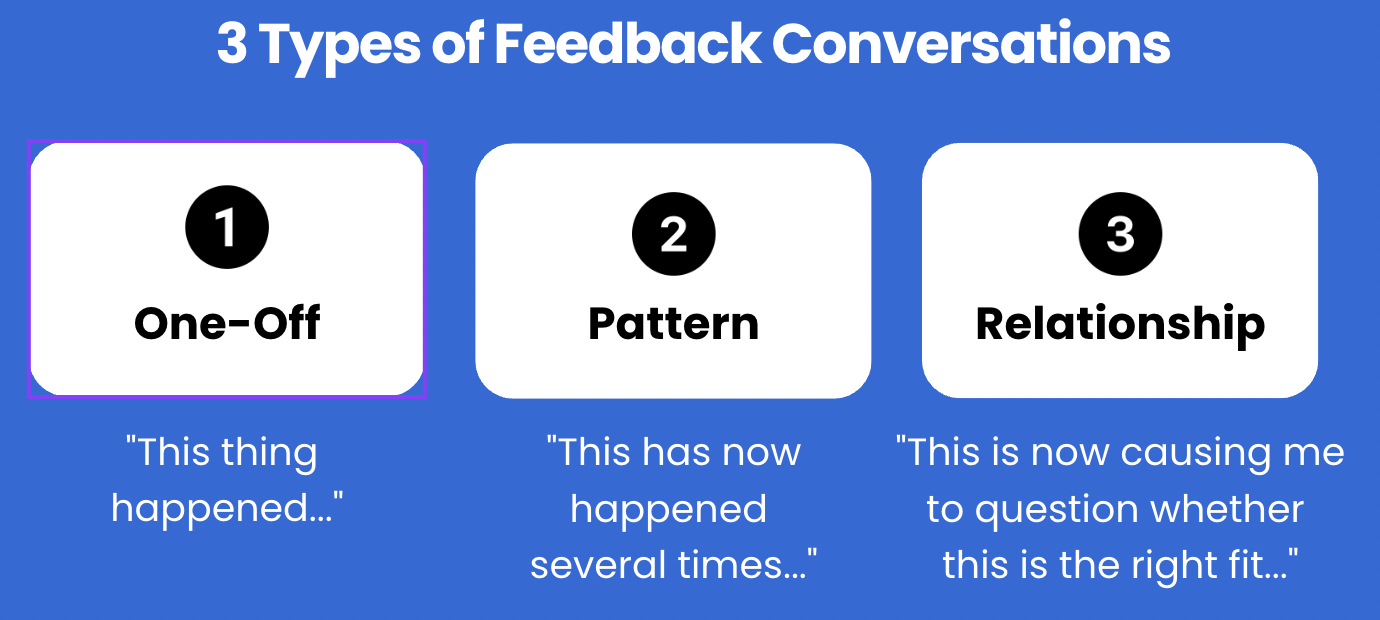
Here’s a helpful model for how to ramp up your feedback:
- One-Off: The first time something happens, it’s not a big deal. Just share the feedback and give the person a chance to fix it.
- Pattern: Once an employee has made the same mistake multiple times, you need to call that out. Make it clear you’re noticing a pattern, and they need to fix that pattern before it becomes a big performance issue.
- Relationship: After you’ve called out the pattern and the employee’s performance still isn’t improving, ramp up the conversation further. Explain that this issue—if unaddressed—could cause them to lose their job. For some employees, this type of final warning helps them prioritize and fix the issue once and for all, which is great.
What Step 4 may look like in the situation with Tommy:
- After observing all of Tommy’s recent work issues, it’s clear that his performance hasn’t improved much (if at all) since the last time you gave him feedback. So this time, when you share feedback with Tommy, you ramp up your feedback slightly to make it clear you’re worried about the trend you’re seeing.
- Example Feedback: “Tommy, we’ve talked several times before about your missed timelines and struggle to keep up with client deliverables. I’ve continued to see more instances of those issues, including last week, when you sent X client’s reports on the 10th instead of the 7th, which caused issues because they didn’t have the data they needed for their board meeting. At this point, I’m beginning to get worried about your overall performance at our company.”
Step 5: Give a Warning
One rule of thumb: Try to never terminate an employee without first telling them, “If this behavior doesn’t improve, I may have to let you go.” That type of warning indicates this is a serious issue that needs to improve immediately. The first couple of times I had to fire people, I didn’t say that phrase and they were surprised when I later let them go.
Everyone deserves to know if they need to begin looking for another job, and some employees will remain in denial about their performance issues until they hear a phrase like the one above. The phrase is so clear and direct that it’s hard to ignore.
(Btw, the only time to terminate someone without giving a warning like this is if an employee violates an ethical standard and must be terminated immediately for cause.)
Your goal is that ideally, no one is ever surprised when they’re fired from the company, if it comes to that.
Around this point in your feedback conversations, it’s often helpful to ask yourself one question to determine whether you think the employee is the right fit: “Knowing what you know now about them, would you enthusiastically re-hire them?”
- If the answer is Yes: Great! There’s probably still time to turn around their performance. Keep working with them to help them through this rough spot. Maybe they just need more training or support.
- If the answer is No: It’s unlikely they’ll be able to turn things around. Essentially, what you’re saying is that you’d prefer to flip a coin on a random new hire over continuing with this person, which isn’t a good sign. Consider moving toward termination.
Depending on your company’s standards and local laws, you may also deliver a Performance Improvement Plan (PIP), which is a formal, written warning to the employee. Partner with your HR team to determine whether and how you should fill out that type of written warning.
What Step 5 may look like in the situation with Tommy:
- The situation with Tommy still hasn’t improved. He’s still a nice guy and the team still likes him, but they no longer trust him—and neither do you.
- You want to be clear with Tommy that he needs to improve (and fast) to remain in his job.
- Example Feedback: “Tommy, we’ve had a lot of conversations about your performance recently, and I’m still not seeing improvement. As much as I hate to say this, unless you can strongly improve your task completion and organization, I don’t think this job will be the right fit for you. We may end up having to let you go. What I want to see from you in the next week is X, Y, and Z.”
Step 6: Let Them Go (If Necessary)
Termination is always the last option. If you end up getting to the point of letting the employee go, follow these tips to make the process as smooth as possible:
- Ensure someone else like HR or a senior leader joins you in the termination discussion. (This is often necessary for legal reasons.)
- Partner with HR to gather country-specific information you should share on the call about the employee’s last paycheck, employee benefits, etc.
- Prepare what you’re going to say in advance, and consider role-playing the conversation to get more familiar with your talk track.
- Generally, for termination discussions, the shorter, the better. Most of these conversations should last no longer than 5-15 minutes.
- If the employee tries to argue your decision to let them go (which does happen sometimes), redirect by saying you’ve already made the decision and the purpose of this call is to discuss next steps. Remain focused on explaining the information they need to know and answering their logistical questions without getting caught in debating their performance.
- Be firm but gracious. There’s no need at this point to say negative things about their performance. After all, you’ve already shared all of that feedback with them multiple times in past discussions.
What Step 6 may look like in the situation with Tommy:
- Schedule time with your HR team to discuss logistics like who is joining the call, when it’s happening, and who is saying what on the call. Often, it’s common to invite an HR team member to join your next 1-on-1 with Tommy or schedule an ad hoc meeting with him to have this discussion.
- Right after the call begins, tell Tommy that today will be his last day at the company. Explain the basics he needs to know (as explained above) and tell him you can address any of his immediate questions.
- Work with HR to discuss what to say on this call, but here’s a sample talk track for the beginning of that conversation: “Tommy, I wanted to let you know that this will be your last day at the company. As we’ve discussed in the past, your performance isn’t aligning with our company’s expectations, so this role isn’t the right fit for you. That said, you’re a smart guy and I know you’ll find somewhere else you can be happy and successful. I wanted to explain a few logistics about your final paycheck and what happens from here...”
Sharing tough feedback and firing someone is the toughest part of being a manager.
Every time I know I need to fire a team member, I lose sleep over it—and I hope I continue to get that pain in my gut every time for the rest of my life because firing shouldn’t be taken lightly. It’s a big deal. We’re talking about someone’s livelihood, so these conversations should be handled with grace and tact.
But even though the process is gut-wrenching, I promise it will go much smoother for everyone involved if you follow the tips shared above.
Best of luck, and never hesitate to reach out if I can ever help with anything.