Be Efficient with Processes and Effective with People
I’m a bit weird.
When I go to the grocery store, I obsess over which path of picking up groceries will require the fewest steps, and I get annoyed if I choose a suboptimal path.
When I run errands around town, I mentally map out my route to ensure I won’t have to unnecessarily double back on any roads.
When my wife tells me she's ready to leave the house to go on a walk, I sometimes get frustrated if she's not ready to go once my shoes are on. (Definitely not my best quality.)
These tendencies are partially connected to my impatience, but they’re more firmly rooted in my relentless desire to not waste a second of precious life. (If this sounds unhealthy, that’s probably because it is.)
Several years ago, I realized that I was applying this same relentless efficiency to some of my relationships.
I’d be in a 1-on-1 with one of my direct reports, and if they weren’t coming to the point fast enough, I’d interrupt and skip to address whatever I knew they were asking about.
Or someone would come to me with a difficult life problem, and I’d suggest solutions rather than listening and letting them come to their own (often much better) solution.
Around this time, I realized that I could no longer let efficiency be the driving force of every aspect of my life.
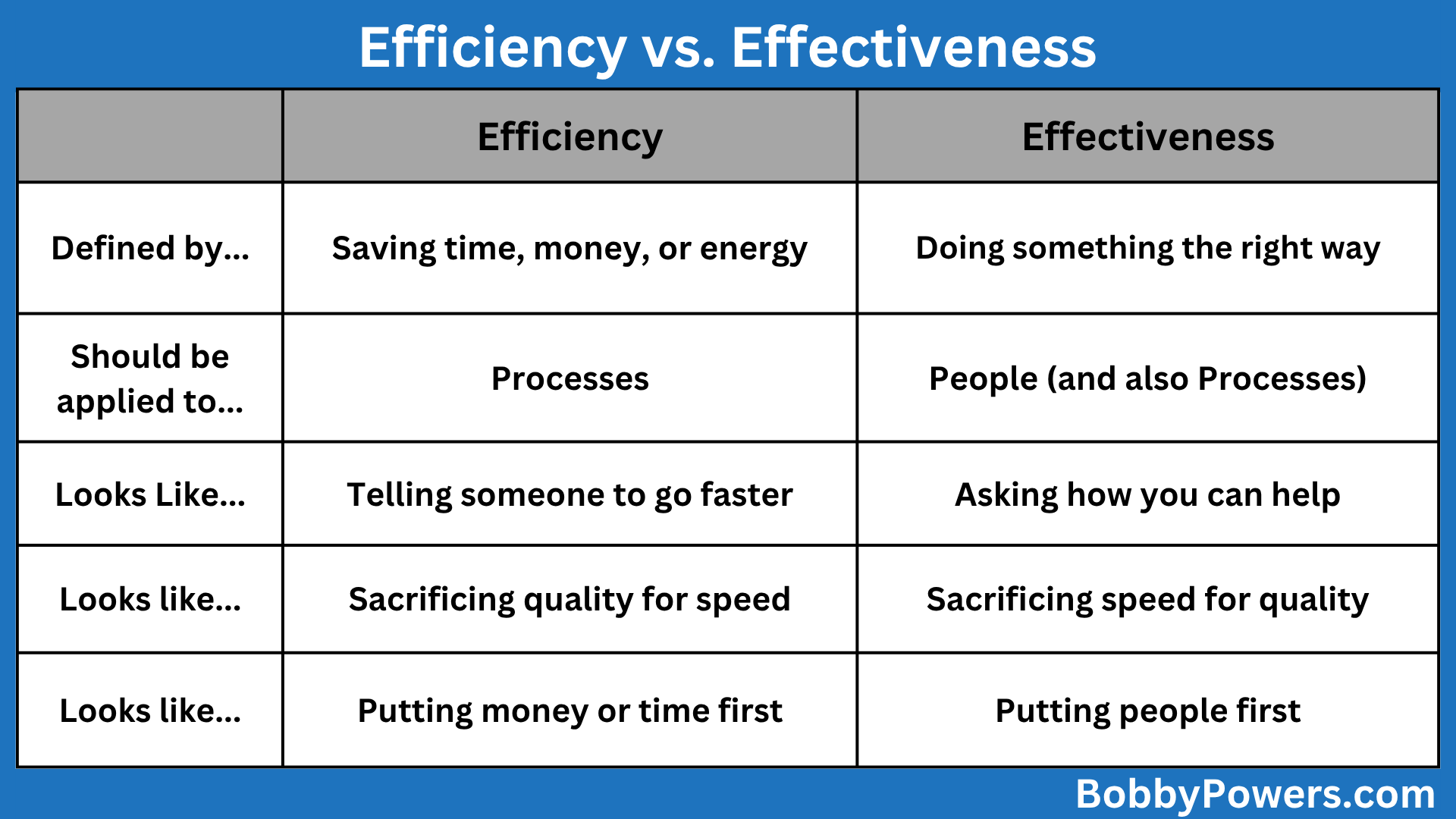
Efficiency is a worthwhile, reasonable aspiration when trying to solve process problems (writing software code, building a spreadsheet, designing an assembly line, etc.). But it’s the wrong driving force when dealing with people.
Human relationships don’t function on the continuum of efficient versus inefficient. They function in the realm of effective versus ineffective.
First, a quick definition of terms:
- Efficient = “Doing something in a good, careful and complete way with no waste of time, money or energy”
- Effective = “Producing the result that is wanted or intended; producing a successful result”
The former is optimization: you're squeezing the juice out of a process to make it better, faster, or cheaper. But squeezing humans doesn’t lead to a positive outcome. It leads to unempathetic conversations and damaged relationships.
The latter is prioritization: you’re putting people first and ensuring that something is done the right way — not necessarily the fastest way. Humans aren’t robots, and we screw up things when we treat them as such.
- Automating an Excel spreadsheet with formulas, conditional formatting, and dependent cell referencing
- Simplifying software code to speed up processing time and make it easier to debug and maintain
- Cutting out unnecessary steps from a cumbersome process
- Empowering people to make decisions rather than requiring approval
But here are some of the mistakes I’ve made when I’ve applied efficiency in the wrong situations:
- Not inviting some stakeholders to meetings because I thought they’d slow down the process (even though they’d probably help us reach a better decision)
- Cutting off a 1-on-1 to head to another meeting even though the person just brought up a big topic that warrants discussion
- Shipping a project too quickly because I wanted to move on to the next thing
- Multitasking by checking email or Slack messages during a meeting
3 Ways to Be More Effective with People
Lately, I’ve been trying to prioritize effectiveness instead of efficiency in my interactions with others. These tactics have been helpful in that effort:
1. Recognize that some moments are supposed to move slowly
Several times, I’ve had team members cry during a 1-on-1. One person was heading toward a possible divorce, another had a family member with a medical issue, and a third was feeling really burnt out.
In situations like these, speed is not your friend. These situations are built for sitting in silence together—just being there for someone. They’re not meant to be rushed. These are the kinds of situations when I now just sit there and let the meeting run long, even if it will make me late for my next appointment.
Many situations call for slowness, not speed. Take time to recognize those moments.
2. When possible, avoid booking another meeting right after a 1-on-1
I used to book all of my meetings back-to-back because it felt more efficient. But I kept running into situations where a team member would bring up something significant at the end of a 1-on-1, and I’d have to decide whether to cut them off so I could show up to my next meeting on time.
It was a double bind because I’d either have to short-change the person in front of me or the person in my next meeting, and neither felt like the right thing to do.
Now, I often try to give myself a little wiggle room in the calendar between 1-on-1s. I’m sacrificing a bit of efficiency to do this, but it feels like a good tradeoff.
3. Remember that the most effective path often ends up also being faster in the long term
This is one of the mental tricks I use on myself. Because my brain is hard-wired for efficiency, I sometimes have to remind myself that optimizing for effectiveness (the best way to do things) also ends up resulting in long-term efficiency (the fastest way to do things).
I realized this earlier in my career when I was rolling out a new communication process at my company. My tendency is to ship projects quickly and move on to the next thing, but one executive encouraged me to slow down and roll out the process piecemeal: one element in March, another in April, etc.
At first, I thought to myself, “That’s way too freaking slow! We can’t wait four months to roll this out!” But it turned out that doing it the slow way helped the company adopt the process change at an appropriate pace. By moving more slowly, we actually got faster adoption. (Funny how that works, huh?)
This is the power of effectiveness.
If you apply efficiency to the wrong situations, you’ll damage relationships and often generate worse results.
Processes can and should be streamlined for efficiency. People shouldn’t.
To get the most out of your people, you have to want the most for them. That means treating everyone in a humane, caring, and empathetic way—putting their needs and emotions first and ensuring they get the support they need.
People need to be cared for, loved, appreciated, and respected — all of which take time. In every relationship, focus on quality and authenticity rather than quantity and productivity.