Book Summary: “Switch”
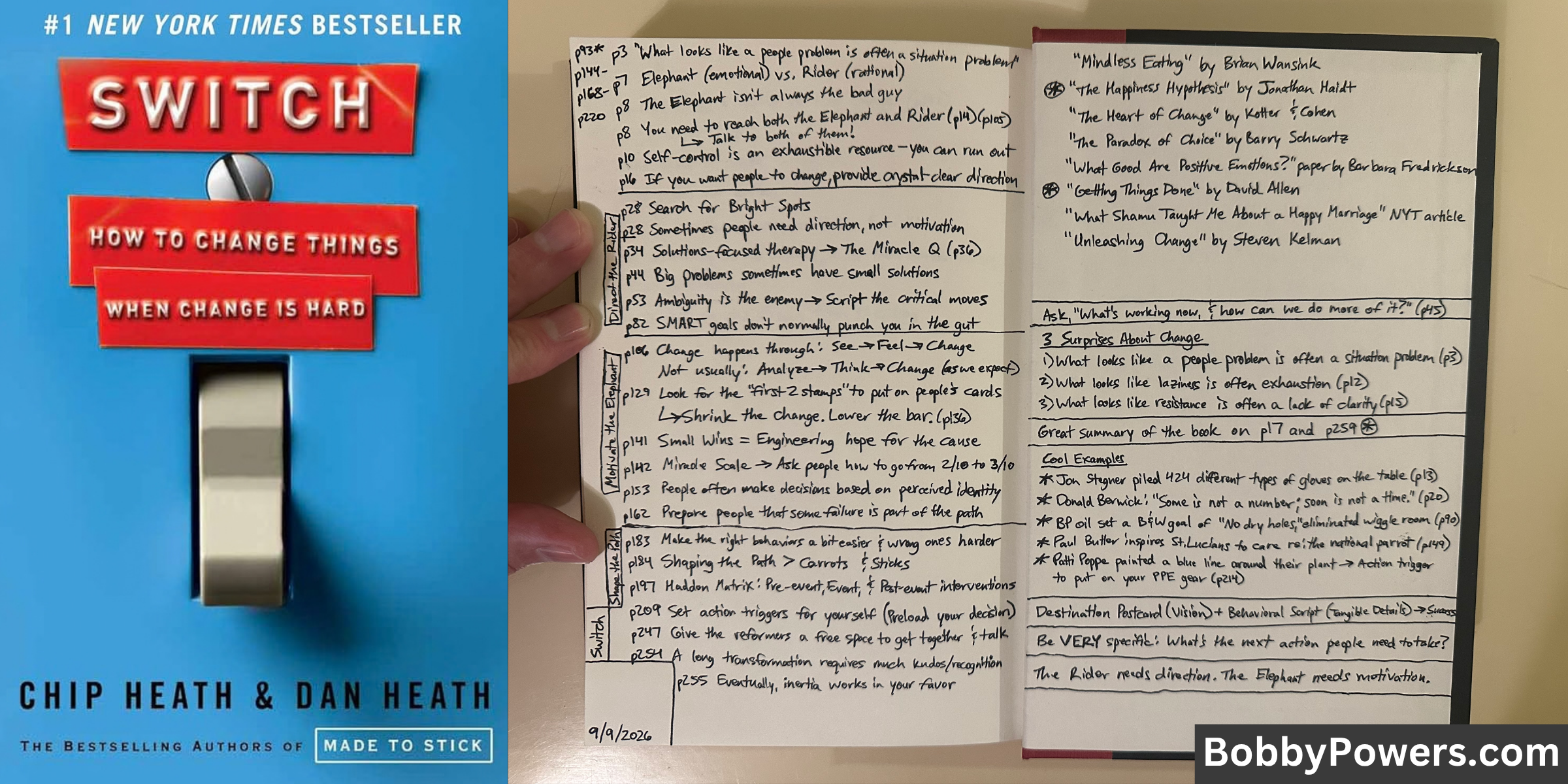
I write in the back cover of every book I read, as shown above.
To learn more about my book notes system, click here.
Book: Switch by Chip and Dan Heath
Reviewer: Bobby Powers
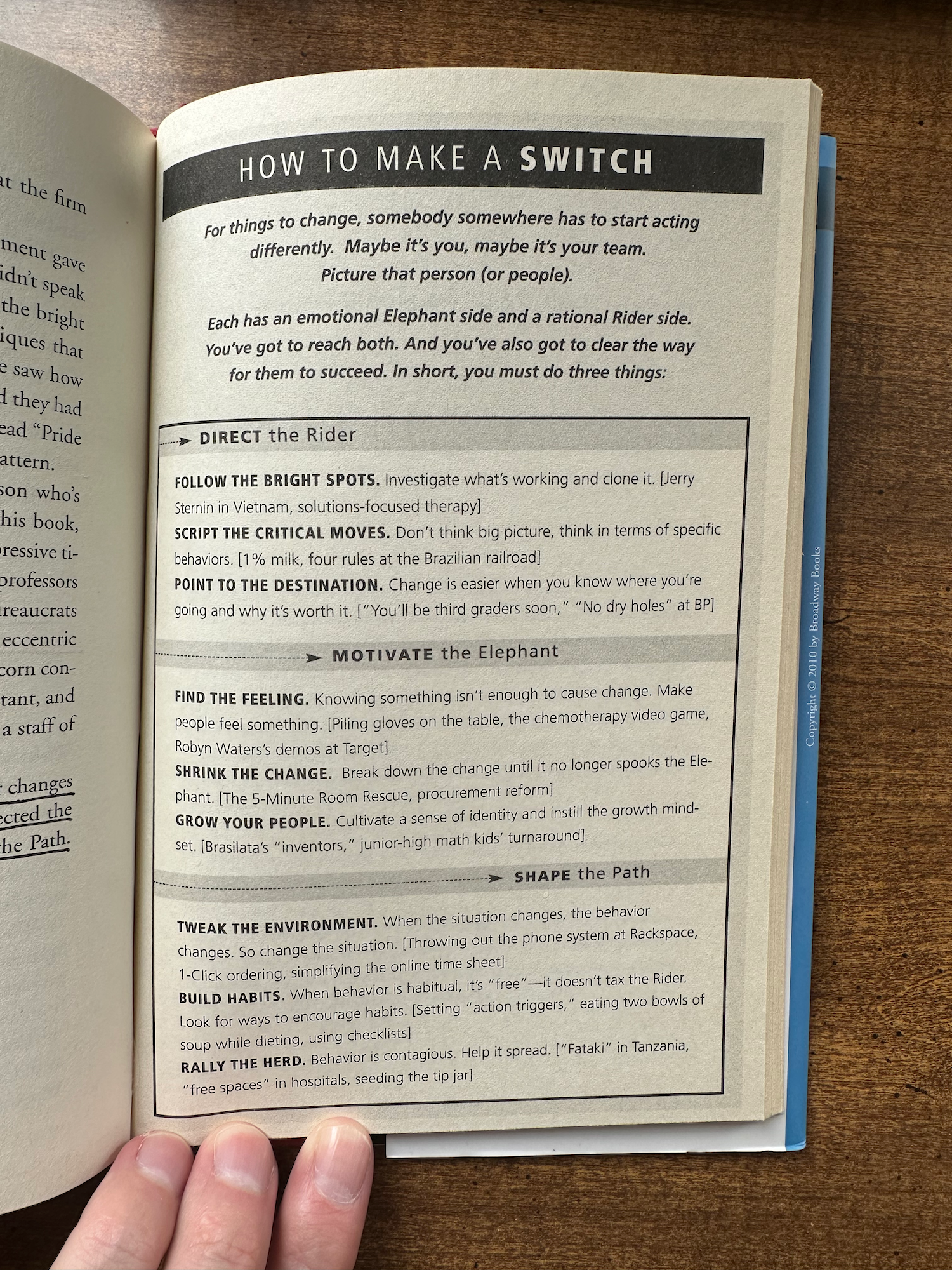
My 3 Biggest Takeaways
Background: This book's core framework draws upon an analogy from Jonathan Haidt's book The Happiness Hypothesis.
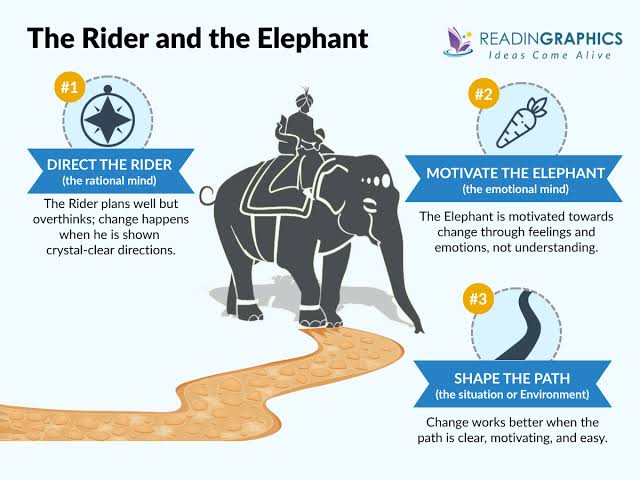
"Haidt says that our emotional side is an Elephant and our rational side is its Rider. Perched atop the Elephant, the Rider holds the reins and seems to be the leader. But the Rider's control is precarious because the Rider is so small relative to the Elephant. Anytime the six-ton Elephant and the Rider disagree about which direction to go, the Rider is going to lose. He's completely overmatched."
 Direct the Rider
- "If you want people to change, you must provide crystal-clear direction...you don't ask them to 'act healthier.' You say, 'Next time you're in the dairy aisle of the grocery store, reach for a jug of 1% milk instead of whole milk.'"
- Find bright spots. See who is having an undue amount of success and study what they're doing differently than others.
 Motivate the Elephant
- "When change works, it's because leaders are speaking to the Elephant as well as to the Rider."
- "In almost all successful change efforts, the sequence of change is not ANALYZE-THINK-CHANGE, but rather SEE-FEEL-CHANGE." (Based on research from Kotter and Cohen)
- In other words, once you help someone FEEL something, then they'll decide to ACT.
 Shape the Path
- "Tweaking the environment is about making the right behaviors a little bit easier and the wrong behaviors a little bit harder."
- Rather than defaulting to motivation with carrots and sticks, consider what's making the desired behavior difficult for people. Ask them about it and make changes based on what they share.
"If you want to change things, you've got to appeal to both. The Rider provides the planning and direction, and the Elephant provides the energy. So if you reach the Riders of your team but not the Elephants, team members will have understanding without motivation. If you reach their Elephants but not their Riders, they'll have passion without direction." -Chip and Dan Heath
Selected Quotes & Ideas from the Book
- Analogy: The Rider and the Elephant
- "Changes often fail because the Rider simply can't keep the Elephant on the road long enough to reach the destination."
- "The weakness of the Elephant, our emotional and instinctive side, is clear: It's lazy and skittish, often looking for the quick payoff (ice cream cone) over the long-term payoff (being thin). When change efforts fail, it's usually the Elephant's fault, since the kinds of change we want typically involve short-term sacrifices for long-term payoffs."
- "But what may surprise you is that the Elephant also has enormous strengths and that the Rider has crippling weaknesses. The Elephant isn't always the bad guy. Emotion is the Elephant's turf—love and compassion and sympathy and loyalty...And even more important if you're contemplating a change, the Elephant is the one who gets things done."
- "The Rider tends to overanalyze and overthink things."
- "And even more important if you're contemplating a change, the Elephant is the one who gets things done...The Rider tends to overanalyze and overthink things."
- "It's easy to make a presentation that only speaks to the Rider. But if you do that, you won't effect any change. If you want to get people to change, you need to get their Elephant on your side.
- "So if you reach the Riders of your team but not the Elephants, team members will have understanding without motivation. If you reach their Elephants but not their Riders, they'll have passion without direction."
- 3 Surprises about change:
- "What looks like a people problem is often a situation problem."
- "What looks like laziness is often exhaustion."
- "What looks like resistance is often a lack of clarity."
- STEP 1: Direct the Rider
- If a couple has been fighting, a solutions-focused therapist may ask these types of questions:
- The Miracle Question: "Suppose that you go to bed tonight and sleep well. Sometime, in the middle of the night, while you are sleeping, a miracle happens and all the troubles that brought you here are resolved. When you wake up in the morning, what's the first small sign you'd see that would make you think, 'Well, something must have happened—the problem is gone!'?"
- The Exception Question: "When was the last time you saw a little bit of the miracle, even just for a short time?"
- "Knowledge does not change behavior. We have all encountered crazy shrinks and obese doctors and divorced marriage counselors." -Jerry Sternin
- "Big problems are rarely solved with commensurately big solutions. Instead, they are most often solved by a sequence of small solutions, sometimes over weeks, sometimes over decades."
- "To pursue bright spots is to ask the question, 'What's working, and how can we do more of it?'"
- "Ambiguity is the enemy. Any successful change requires a translation of ambiguous goals into concrete behaviors. In short, to make a switch, you need to script the critical moves."
- "We want what we might call a destination postcard—a vivid picture from the near-term future that shows what could be possible."
- "When you're at the beginning, don't obsess about the middle, because the middle is going to look different once you get there. Just look for a strong beginning and a strong ending and get moving."
- If a couple has been fighting, a solutions-focused therapist may ask these types of questions:
- STEP 2: Motivate the Elephant
- "In looking for a goal that reaches the Elephant—that hits people in the gut—you can't bank on SMART goals...In the 1980s, a major study of corporate change efforts found that financial goals inspired successful change less well than did more emotional goals, such as the goal to provide better service to customers or to make more useful products."
- "People find it more motivating to be partly finished with a longer journey than to be at the starting gate of a shorter one...That sense of progress is critical, because the Elephant in us is easily demoralized."
- "You need to lower the bar. Picture taking a high-jump bar and lowering it so far that it can be stepped over. If you want a reluctant Elephant to get moving, you need to shrink the change."
- "When you engineer early successes, what you're really doing is engineering hope."
- "When you improve a little each day, eventually big things occur...Don't look for the quick, big improvement. Seek the small improvement one day at a time. That's the only way it happens—and when it happens, it lasts." -John Wooden
- "In the identity model of decision making, we essentially ask ourselves three questions when we have a decision to make: Who am I? What kind of situation is this? What would someone like me do in this situation?"
- "Everything can look like a failure in the middle." -Rosabeth Moss Kanter
- STEP 3: Shape the Path
- "To change someone's behavior, you've got to change that person's situation."
- "Is it possible to design an environment in which undesired behaviors—whether yours or your colleagues'—are made not only harder but impossible?"
- Action Triggers: A decision to perform a specific ACTION when you encounter a certain situational TRIGGER.
- "A good change leader never thinks, 'Why are these people acting so badly? They must be bad people.' A change leader thinks, 'How can I set up a situation that brings out the good in these people?'"
- "Every culture, whether national or organizational, is shaped powerfully by its language."
- "If you want to change the culture of your organization, you've got to get the reformers together. They need a free space. They need time to coordinate outside the gaze of the resisters."
- "Although inertia may be a formidable opponent in the early goings of your switch, at some point inertia will shift from resisting change to supporting it. Small changes can snowball to big changes."
- Self-control
- "Self-control is an exhaustible resource."
- We burn our reserves when we have to control ourselves in situations like managing our impression on others, speaking with tact in a difficult conversation, or trying not to eat a cookie.
- "The bigger the change you're suggesting, the more it will sap people's self-control."
Think you’d like this book? Buy it here:
Other books you may enjoy:
- Reset: How to Change What’s Not Working by Dan Heath
- The Culture Map by Erin Meyer
- It Doesn't Have to Be Crazy at Work by Jason Fried and David Heinemeier Hansson
Other notable books by the authors: