Book Summary: “It Doesn’t Have to Be Crazy at Work”
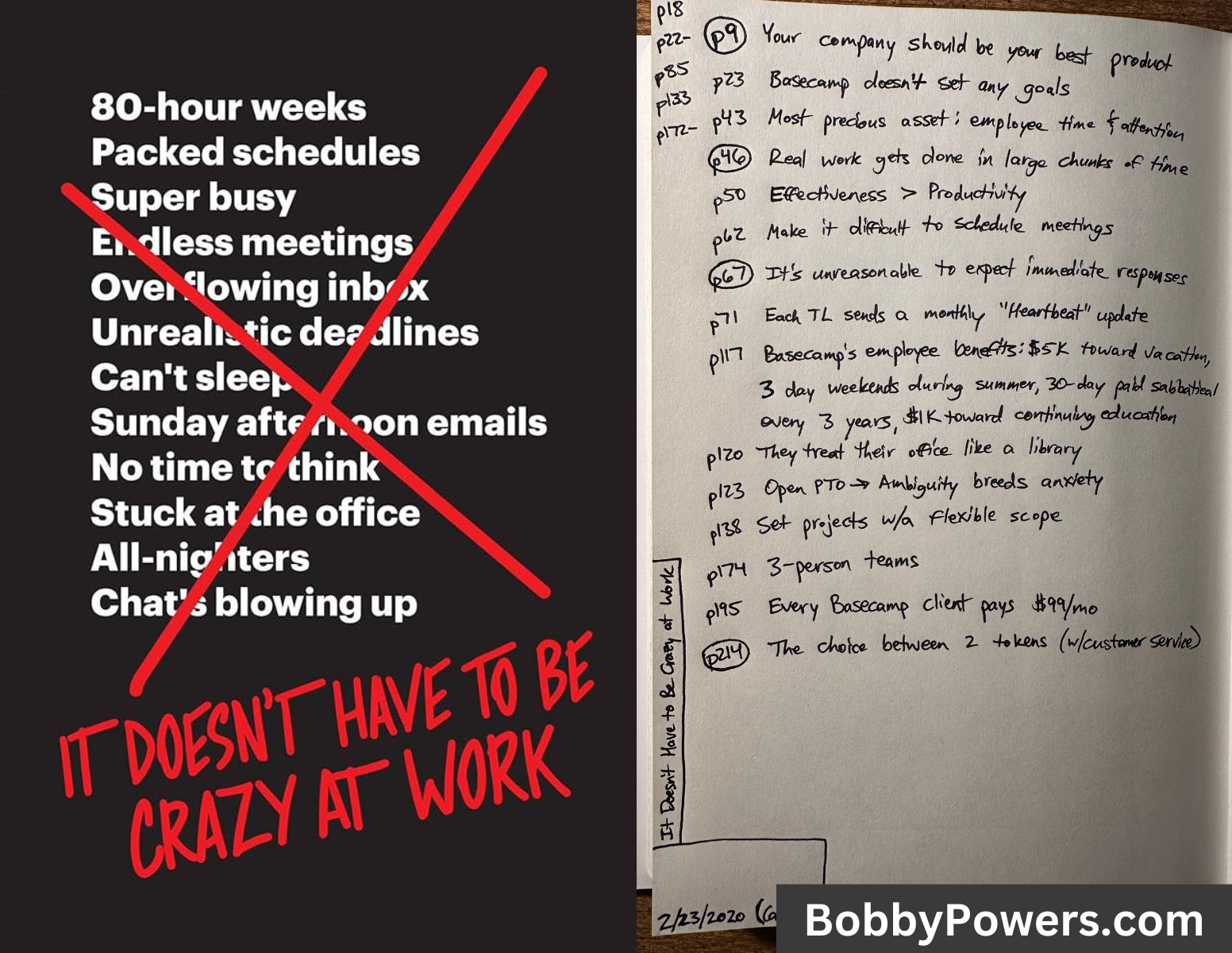
I write in the back cover of every book I read, as shown above.
To learn more about my book notes system, click here.
Book: It Doesn't Have to Be Crazy at Work by Jason Fried and David Heinemeier Hansson (DHH)
Reviewer: Bobby Powers
My 3 Biggest Takeaways
 Think of your company as a product
- "Your company is a product. Yes, the things you make are products (or services), but your company is the thing that makes those things. That's why your company should be your best product."
- "When you think of the company as a product, you ask different questions: Do people who work here know how to use the company? Is it simple? Complex? Is it obvious how it works? What's fast about it? What's slow about it? Are there bugs? What's broken that we can fix quickly and what's going to take a long time?"
 Don't expect urgent responses to non-urgent internal messages
- "In almost every situation, the expectation of an immediate response is an unreasonable expectation. Yet with more and more real-time communication tools creeping into daily work—especially instant-messaging tools and group chat—the expectation of an immediate response has become the new normal. This is not progress."
- "Almost everything can wait. And almost everything should."
- "At Basecamp, we've tried to create a culture of eventual response rather than immediate response. One where everyone doesn't lose their shit if the answer to a nonurgent question arrives three hours later. One where we not only accept but strongly encourage people not to check email, or chat, or instant message for long stretches of uninterrupted time."
 Overly empathize with customer concerns
- "People don't like to have their grievances downplayed or dismissed. When that happens, even the smallest irritation can turn into an obsessive crusade...Jean-Louis Gassée, who used to run Apple France, describes this situation as the choice between two tokens. When you deal with people who have trouble, you can either choose to take the token that says 'It's not a big deal' or the token that says 'It's the end of the world.' Whichever token you pick, they'll take the other."
"The answer isn't more hours, it's less bullshit. Less waste, not more production. And far fewer distractions, less always-on anxiety, and avoiding stress." -Fried and Hansson
Selected Quotes & Ideas from the Book
- Background
- Fried and Hansson co-founded Basecamp. Jason is CEO, and David is CTO.
- Basecamp has taken zero VC funding.
- As of the time this book was written, they had 54 employees spread across 30 different cities around the world.
- "As of the printing of this book, we have more than 100,000 companies that pay on a monthly basis for Basecamp."
- "Sustained exhaustion is not a badge of honor, it's a mark of stupidity."
- "It's time for companies to stop asking their employees to breathlessly chase ever-higher, ever-more artificial targets set by ego. It's time to give people the uninterrupted time that great work demands. It's time to stop celebrating crazy at work."
- "(At Basecamp) We put in about 40 hours a week most of the year and just 32 in the summer. We send people on month-long sabbaticals every three years. We not only pay for people's vacation time, we pay for the actual vacation, too."
- "We work on projects for six weeks at a time, then we take two weeks off from scheduled work to roam and decompress."
- Interesting, well-balanced work examples from various creative professionals:
- "Charles Darwin published 19 books, including 'On the Origin of Species,' while working just 4.5 hours a day."
- "Novelist Isabel Allende has two offices, one just for writing that has no internet or telephone, and another for tackling administrative tasks."
- "Pulitzer Prize-winning author Colson Whitehead writes for just five hours a day and takes a year off between projects to play video games and cook."
- "Television producer and screenwriter Shonda Rhimes runs multiple primetime shows while sticking to a policy of not answering phone calls or returning emails after 7 PM and during weekends."
- "Charles Dickens maintained a strict schedule comprising five hours of writing in silence, followed by a three-hour walk."
- "Entrepreneurship doesn't have to be this epic tale of cutthroat survival. Most of the time it's way more boring than that. Less jumping over exploding cars and wild chase scenes, more laying of bricks and applying another layer of paint."
- They don't set goals at their company. "Because let's face it: Goals are fake. Nearly all of them are artificial targets set for the sake of setting targets...Plus, there's an even darker side to goal setting. Chasing goals often leads companies to compromise their morals, honesty, and integrity to reach those fake numbers. The best intentions slip when you're behind."
- "Meetings tend to break time into 'before' and 'after.' Get rid of those meetings and people suddenly have a good stretch of time to immerse themselves in their work. Time and attention are best spent in large bills, if you will, not spare coins and small change."
- "People aren't working longer and later because there's more work to do all of a sudden. People are working longer and later because they can't get work done at work anymore!"
- "We don't require anyone to broadcast their whereabouts or availability at Basecamp. No butts-in-seats requirement for people at the office, no virtual-status indicator when they're working remotely. 'But how do you know if someone's working if you can't see them?' Same answer as this question: 'How do you know if someone's working if you can see them?' You don't. The only way to know if work is getting done is by looking at the actual work."
- "The fact is that the higher you go in an organization, the less you'll know what it's really like. It might seem perverse, but the CEO is usually the last to know. With great power comes great ignorance."
- "We look for candidates who are interesting and different from the people we already have."
- "Unlimited vacation is a stressful benefit because it's not truly unlimited. Can someone really take five months off? No. Three? No. Two? One? Maybe? Is it weeks or months? Who's to know for sure? Ambiguity breeds anxiety."
- "Following group chat at work is like being in an all-day meeting with random participants and no agenda."
- "There is nothing so useless as doing efficiently that which should not be done at all." -Peter Drucker
- "Just like work expands to fill the time available, work expands to fill the team available. Small, short projects quickly become big, long projects when too many people are there to work on them."
Think you’d like this book? Buy it here:
Other books you may enjoy:
Other notable books by the authors: