Book Summary: “Confessions of a Public Speaker”
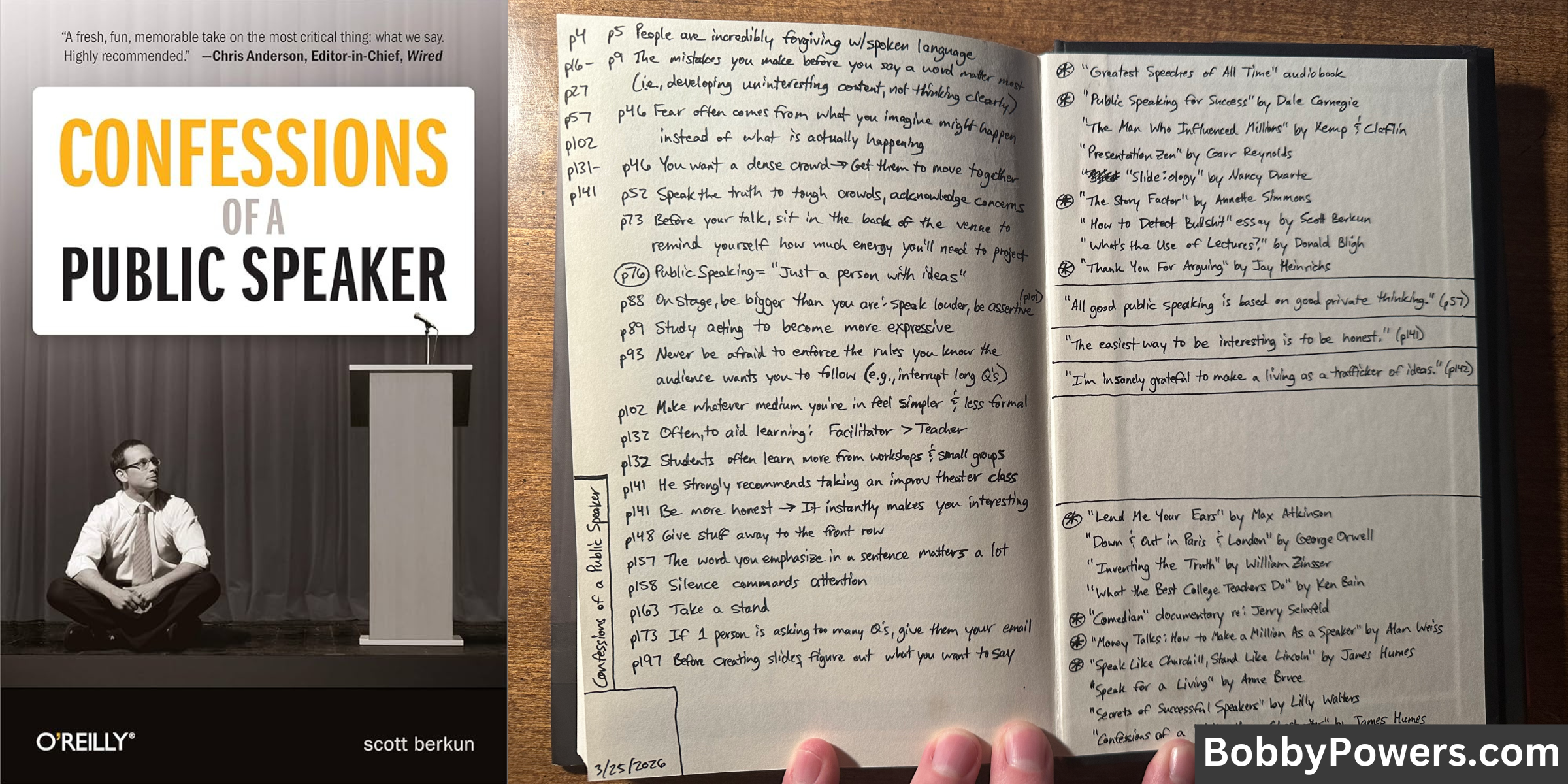
I write in the back cover of every book I read, as shown above.
To learn more about my book notes system, click here.
Book: Confessions of a Public Speaker by Scott Berkun
Reviewer: Bobby Powers
My 3 Biggest Takeaways
 Your response to mistakes dictates the audience's response
- Mistakes happen. Don't let them affect you.
- "If you listen to Martin Luther King, Malcolm X, or Winston Churchill, and then read the unedited transcripts of those same speeches, you'll find mistakes. However, they're mistakes we commonly ignore because we're incredibly forgiving of spoken language."
- "It's often the case that the things speakers obsess about are the opposite of what the audience cares about. They want to be entertained. They want to learn. And most of all, they want you to do well. Many mistakes you can make while performing do not prevent those things from happening. It's the mistakes you make before you even say a word that matter more. These include the mistakes of not having an interesting opinion, of not thinking clearly about your points, and of not planning ways to make those points relevant to your audience. Those are the ones that make the difference. If you can figure out how to get those right, not much else will matter."
 The most important thing is the substance of your talk
- I've attended a ton of eloquent but meaningless and thoughtless talks. Don't give one of those.
- "Even for many smart people working on a presentation, they're so seduced by style that they lose the substance. They worry about slide templates, images, movies, fonts, clothes, hair, and the rest, forgetting to do the harder and more important work of thinking deeply about what points they want to make. It is possible to become an eloquent speaker, who makes beautiful slides and has a great vocabulary and perfect diction, without having much to say."
- "All good public speaking is based on good private thinking."
 Handle tough crowds by speaking the truth
- "If people are angry or rowdy, it means they care about something. They have some energy they are willing to contribute, for better or for worse. If you can figure out what it is they're interested in, preferably early on, it's possible to connect with them. Find common ground and bring it to the surface. Their hate will quickly turn to respect, as you've said the thing on stage they've never heard someone like you say before. After watching and giving hundreds of lectures, I've learned that by far the thing people seem angriest about is dishonesty. Show some integrity by speaking the truth on the very thing that angers them, or even acknowledging it in a heartfelt way, and you will score some points. People with the courage to speak the truth into a microphone are exceptionally rare."
"The problem with most bad presentations I see is not the speaking, the slides, the visuals, or any of the things people obsess about. Instead, it's the lack of thinking."
Selected Quotes & Ideas from the Book
- "[Mistakes] occur on average once every ten words...If people say an average of 15,000 words each day, that's about 1,500 verbal blunders a day." -Michael Erard author of Um
- "Know that your response to a mistake defines the audience's response."
- "There are two types of speakers: those that are nervous and those that are liars." -Mark Twain
- "I've never gotten over what they call stage fright. I go through it every show." -Elvis Presley
- A few ways to reduce physical stress before speaking:
- "Getting to the venue early so you don't have to rush"
- "Doing tech and sound rehearsal well before your start time"
- "Walking around the stage so your body feels safe in the room"
- "Sitting in the audience so you have a physical sense of what they will see"
- "Talking to some people in the audience before you start (if it suits you), so it's no longer made up of strangers"
- Berkun makes $5,000 per lecture and he says some other speakers even make $30,000 or more. (Note: This book was published in 2010.)
- "In the interest of transparency and satisfying your curiosity, I average 25-30 lectures a year. Sometimes I'm paid as much as $8,000, depending on the situation. Maybe one-third are paid only in travel expenses or small fees, since they're self-promotional or for causes I'd like to help. Roughly 40% of my income is from book royalties and the rest from speaking and workshop fees. So far, I average around $100,000 a year, less than I made at Microsoft. However, I work fewer hours, am free from the 9 to 5 life, and have complete independence, which is worth infinitely more. I limit travel to once or twice a month, which means I turn away many gigs; I'd prefer to have more time than money, since you can never earn more time."
- Example speaker fees he provides for some extremely well-known speakers for a 1-hour lecture:
- Bill Clinton: $150,000+
- Katie Couric: $100,000
- Malcolm Gladwell: $80,000
- David Allen: $50,000-75,000
- Rachel Ray: $50,000
- Dave Barry: $25,000-30,000
- "To make and practice a new lecture takes two days of full-time work, which is 16 hours."
- "I'm paid for the decades of experience listed on my resume that, in theory, should make what I have to say interesting."
- Dealing with difficult rooms to present in
- "While you are in the audience looking up at the stage, a stage designed to make me easy to see, often I can't see anything. All the house lights are aimed right at my face."
- "I realized that the crowd size is irrelevant—what matters is having a dense crowd. If ever you face a sparsely populated audience, do whatever you have to do to get them to move together. You want to create a packed crowd located as close as possible to the front of the room."
- If you have a small crowd in a big room, "your energy can never effectively reach everyone because it will be eaten by all the dead space." So you need to ask people to get up and move toward the front, near each other.
- "The tricky part is getting people to move. We are a lazy species. I know once I'm seated I'm not very interested in getting up just to sit down again. But the fact is, all of us do what people in authority tell us to do, especially in lecture halls."
- "The size of the room or the crowd becomes irrelevant as long as the people there are together in a tight pack, experiencing and sharing the same thing at the same time."
- "When you have the microphone, it's your room—do whatever you'd like to enhance the audience's experience."
- "Failing to own your turf is the big mistake that can create a tough crowd. If I show up five minutes before I start speaking, I have no idea what the vibe is like. Every audience is different for a thousand reasons."
- "Making a point, teaching a lesson, or conveying a feeling to others first requires thinking, lots and lots of thinking, before the speaking ever happens."
- 4 Keys to great speech preparation:
- "Take a strong position in the title. All talks and presentations have a point of view, and you need to know what yours is."
- "Think carefully about your specific audience. Know why they are there, what their needs are, what background knowledge they have, the pet theories they believe in, and how they hope their world will be different after your lecture is over."
- "Make your specific points as concise as possible. If it takes 10 minutes to explain what your point is, something is very wrong. Points are claims. Arguments are what you do to support your points. Every point should be compressed into a single, tight, interesting sentence. The arguments might be long, but no one should ever be confused as to what your point is while you are arguing it."
- "Know the likely counterarguments from an intelligent, expert audience. If you do not know the intelligent counterarguments to each of your points, your points cannot be good."
- "It's no surprise that speakers who work without slides use simple outlines or short lists to keep their points. Mark Twain, Winston Churchill, and Franklin Roosevelt all used a short outline of five or six points—often with just a few words per point—to help them recall their hour-long speeches while giving them. If you do enough thinking in advance, all your brain needs is a little list, and most of the speaking will take care of itself."
- "The more effort you put into the clarity of your points, the easier everything else about public speaking becomes."
- "When you strip away all of the layers, like slides and handouts, public speaking becomes intimate and real. It's just a person with ideas."
- "Something is wrong if 60 seconds go by and you aren't already into your first point. Don't waste time giving your resume or telling the back story...They don't care. They almost never need to know how you got where you are...Start with a beat. Think of your opening minute as a movie preview: fill it with drama, excitement, and highlights for why people should keep listening."
- "The biggest advantage I have over every crowd, no matter how smart they are, is that I know what will happen next...This makes the transitions between slides critically important. I have to know what's coming next and set up what I say on the current slide to make the following pay off."
- "The study of acting is not the practice of being fake. It's learning how to become more expressive as yourself and applying that to life on stage and off. All communicators benefit from learning about theater."
- "Always plan and practice to end early."
- "Success often stems from the ability to make whatever medium you're in feel like something simpler and often less formal. It's the art of making the unnatural seem natural."
- Good questions to ask after your talk
- "Was this a good use of your time?"
- "Would you recommend this lecture to others?"
- "Are you considering doing anything different as a result of this talk?"
- "Were you inspired or motivated?"
- "I hear and I forget. I see and I remember. I do and I understand." -Anonymous
- "The best teachers focus on the students' needs. They strive to create an environment where all the pieces students need—emotional confidence, physical comfort, and intellectual curiosity—are present at the same time. The teacher has to get out of the way; instead of being the star, he is the facilitator who helps students gain experience."
- "The easiest way to be interesting is to be honest. People rarely say what they truly feel, yet this is what audiences desire most. If you can speak a truth most people are afraid to say, you're a hero."
- "If you love ideas, speaking and writing are natural consequences. You know about history's great thinkers because they either spoke or they wrote."
- "I'm insanely grateful to make a living as a trafficker of ideas. I hope to be able to do it for the rest of my life."
- "I often bring books to give away during Q&A, but if the front row is empty, I offer a free book to anyone who is willing to move to the front."
- "Nothing kills your power over a room as much as a lack of silence. Silence establishes a baseline of energy in the room. Sometimes when a room is silent, people pay more attention than when you are speaking."
- "Do not start in PowerPoint; start by thinking about and understanding your audience."
- "Plan to have 20-30% of your time slot for Q&A. If you run over, you can eat some of that Q&A time."
Think you’d like this book? Buy it here:
Other books you may enjoy:
Other notable books by the author: