Book Summary: “The Power of Beliefs”
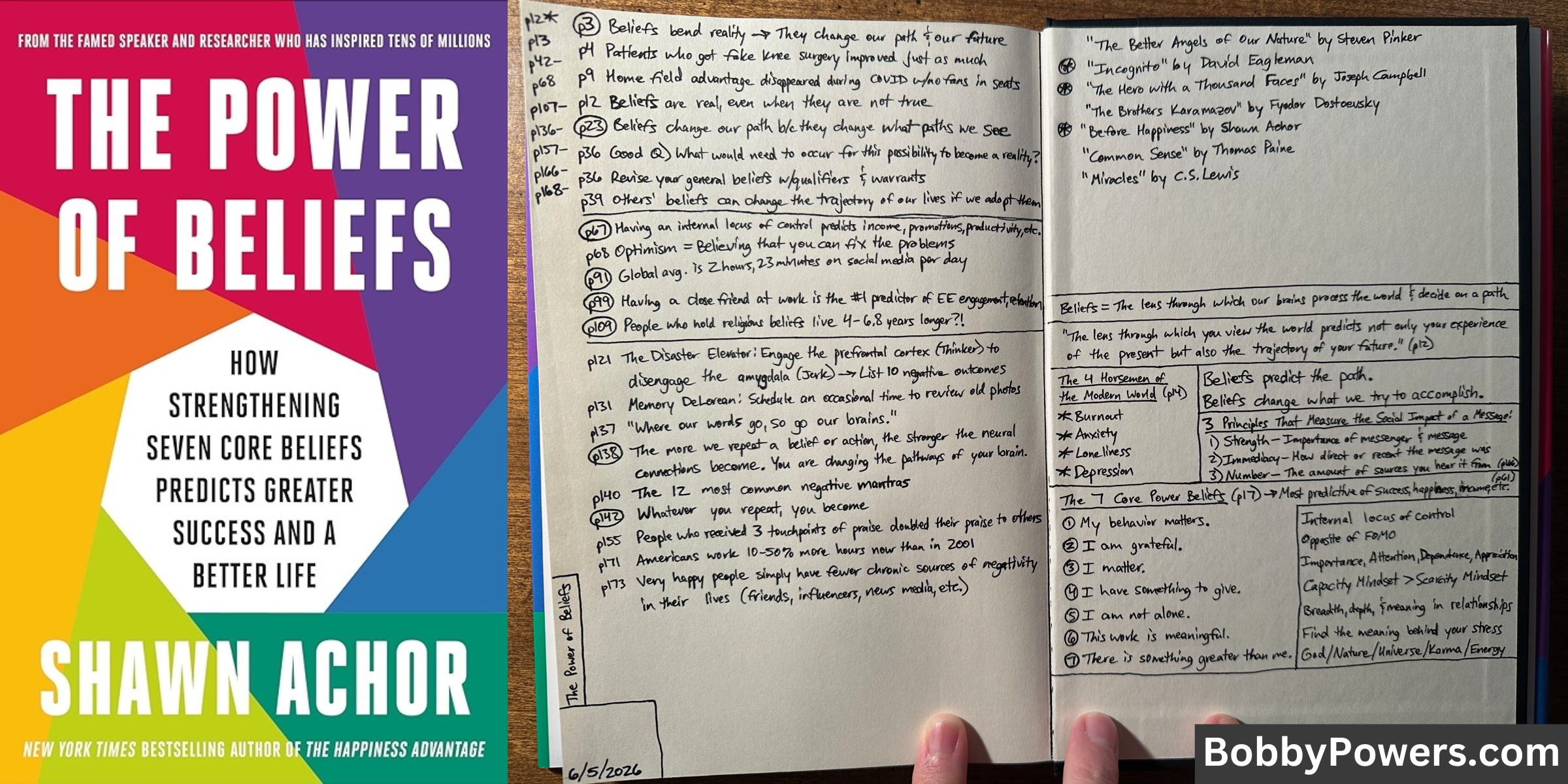
I write in the back cover of every book I read, as shown above.
To learn more about my book notes system, click here.
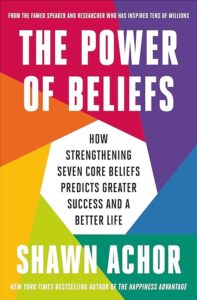
Book: The Power of Beliefs by Shawn Achor
Reviewer: Bobby Powers
My 3 Biggest Takeaways
 Your beliefs predict your path
- "Beliefs are real, even when they are not true."
- "Beliefs change what we try to accomplish."
- "It's not just that beliefs change our long-term outcome, they change how much effort we put in today."
 Having an internal locus of control is a huge predictor of success
- "To summarize decades of research, believing 'My behavior matters' and having an internal locus of control is highly correlated with higher graduation rates, income, likelihood of promotion, SAT scores, longevity, productivity, and sales."
- "Optimism is not the belief that there are no problems. Optimism is a belief that we can fix the problems."
 Many studies indicate that 7 core beliefs predict our health, wealth, and success
- Belief #1: "My behavior matters."
- Belief #2: "I am grateful."
- Belief #3: "I matter."
- Belief #4: "I have something to give."
- Belief #5: "I am not alone."
- Belief #6: "This work is meaningful."
- Belief #7: "There is something greater than me."
"Beliefs about ourselves, others, money, the world—everything from sports superstitions to politics to religious convictions—do more than shape the lens through which we see the world. They shape what happens next. Scientifically speaking, beliefs don't just reflect reality. Beliefs bend reality." -Shawn Achor
Selected Quotes & Ideas from the Book
- "We know there is power in habit, environment, and genes. But stunning new research in this book reveals how seven 'core beliefs' are now increasingly predictive of our future health, success, wealth, and education."
- In a 2002 study, "180 patients who had suffered for years with severe knee osteoarthritis were offered a free knee surgery...The catch, they learned, was that only two-thirds of them would receive a real surgery."
- The other third received a fake surgery (a cut with no real operation).
- Remarkably, the patients who got the sham surgery improved as much as the ones who got the real surgery, and the results held for years.
- Crazy statistics
- "When we believe that our work is meaningful, studies have shown a 31 percent increase in productivity and a 23 percent drop in the negative impacts of stress."
- "When salespeople go from feeling pessimistic to believing that good things can happen, their sales on average rise cross-industry by 37 percent."
- Beliefs in action
- "Beliefs are not facts. They are inherently subjective. Someone who is objectively surrounded by large numbers of people who love them can still believe they are alone and the subjective perception, not the numbers, will shape their reality."
- "If a student is at the top of her class but doesn't believe that 'My work is meaningful' or 'I matter,' then the belief—not the predictions and calculations based on past performance—will significantly impact her long-term trajectory."
- "Our shared beliefs can cause trillions of dollars to evaporate, alter generational wealth, topple regimes, overcome recessions, and create bubbles."
- "The lens through which you view the world predicts not only your experience of the present but also the trajectory of your future."
- "Positive belief does not guarantee outcomes, but it does propel us toward them."
- "It is our attitude at the beginning of a difficult task which more than anything will affect a successful outcome." -William James
- "If you expect the mountain to be insurmountable, you've met the enemy. It's you." -Khang Kijarro Nguyen
- Core Belief #1: "My behavior matters."
- "Think about one of your friends or a child who is struggling, and I'm willing to bet that one of their biggest stumbling blocks is that they believe that whatever they do won't fix the situation."
- "The opposite of happiness is not unhappiness; it is apathy."
- "...people with a strong belief that 'My behavior matters' build wealth significantly faster. Conversely, those with an external locus of control often attribute financial difficulties to external factors such as the economy or government policies rather than something that can be altered through their own behavior. As a result, they don't change or act."
- Core Belief #2: "I am grateful."
- "Remember, in a state of FOMO, we want the reward of someone else's life or experience without any costs, sacrifices, or changes in our own. FOMO is a fantasy that trades off with gratitude."
- One of the foremost sources of FOMO in modern life is social media. It actively pushes us away from gratitude.
- "In a fascinating study by researchers at the University of Pennsylvania, psychologist Melissa Hunt and her colleagues found the more time we spend scrolling through Instagram, Facebook, and Snapchat, the more likely we are to feel lonely and depressed." In a 2018 study, they asked college students to spend no more than 10 minutes per day on each platform for a period of three weeks. "At the end of the three weeks, the participants who limited social media showed significant drops in both loneliness and depression—evidence suggesting not just correlation" but causation.
- "Gratitude doesn't change your surroundings—it changes your seeing. And when you see what is good in front of you, you stop feeling left out of life and start leading it."
- Core Belief #3: "I matter."
- Researcher Gordon Flett found there are 4 main aspects of "mattering": importance, attention, dependence, and appreciation.
- "Our loneliness today may be less a reflection of physical isolation and more a crisis of perceived significance...Loneliness is not about empty rooms but about empty roles. Loneliness is not the absence of people, it is the absence of believing you have a meaningful effect upon others and they upon you."
- "Research shows the belief 'I matter' is not only predictive of our engagement and retention rates at work, but is also one of the greatest predictors of longevity, health, and happiness."
- Core Belief #4: "I have something to give."
- "Shifting from a mindset of lack to one of capacity can unlock deeper connections, foster altruistic behaviors, and expand both our potential and impact, changing our life trajectory."
- "Social media alone proves we have time. The average global social media use a day is two hours and twenty-three minutes." We have time to help others and contribute in our communities if we want to.
- "Being occupied is an objective state. But feeling busy is a belief about our available resources."
- Core Belief #5: "I am not alone."
- "In 2006, when I was a teaching fellow and Kirkland House tutor, I did a study of more than a thousand Harvard students and found that the greatest predictor of their happiness and success was not their SAT scores nor their parents' net worth; it was the breadth, depth, and meaning in their social relationships. I found the correlation between social connection and happiness to be .7, which is significantly higher than the correlation between even smoking and cancer."
- "Gallup's extensive research into workplace engagement revealed that having a close friend at work is the strongest predictor of employee engagement, productivity, and retention."
- Core Belief #6: "This work is meaningful."
- "From a scientific perspective, believing your work is meaningful is one of the greatest drivers of future performance."
- 4 reasons often cited by people who believe their work is meaningful:
- My work helps someone.
- I have friends at work.
- My work helps me grow.
- My job supports people I love.
- Core Belief #7: "There is something greater than me."
- "If we are going to look at the science, I cannot omit this belief. Its impact on human flourishing is one of the most researched and confirmed in science. It is also one of the greatest psychological predictors of the trajectory of your life."
- "This is opposed to a belief that things are random, not morally dictated, and that there is no overarching meaning, God, or structure to our existence beyond ourselves."
- "I believe in God, only I spell it Nature." -Frank Lloyd Wright
- "Spiritual belief significantly improves the quality of life from increased happiness to deepened social connection to longevity. Depending on the study, people who hold religious beliefs live between 4 and 6.8 years longer than those without religious affiliations."
- "The more committed an individual is to their faith tradition, the greater the positive effect it has upon their long-term happiness, longevity, and success..."
- "...regular prayer is strongly associated with lower rates of burnout, anxiety, loneliness, and depression and a higher overall life satisfaction."
- "Your brain will unconsciously save, archive, or delete memories for you unless you take an active role in consciously curating them."
- "When you recall a memory, you're not remembering the event; you are remembering that last time you remembered it." (Idea from neuroscientist Karl Deisseroth)
- "The words you speak become the house you live in." -Hafiz (poet)
- "Where our words go, so go our brains."
- Saying negative phrases like "I'm getting old" often "creates a self-fulfilling decrease in our mental and physical attributes...previous research done by Yale researcher John Bargh and colleagues found that just saying it makes you walk slower, which slows cognition."
- "Whatever you repeat you become."
- "We read to know we are not alone." -William Nicholson
- "The key is to keep company only with people who uplift you, whose presence calls forth your best." -Attributed to Epictetus
- "It is better to surround yourself with people who are better than you, so you can learn from them." -Warren Buffett
- "In a well-known study titled Very Happy People, psychologists Ed Diener and Martin Seligman, the original architects of positive psychology, set out to understand what sets the happiest individuals apart. It wasn't money or health. What they found was that the happiest people simply had fewer chronic sources of negativity in their lives. These happy people didn't live in bubbles or skip hard days they just were surrounded by less constant stress, drama, or low-grade toxicity." (In other words, they didn't have a bunch of negative friends, influencers, or news reporters sharing constant negative messages.)
Think you’d like this book? Buy it here:
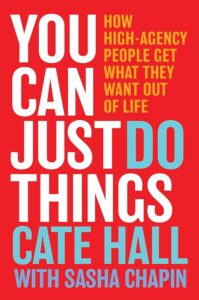
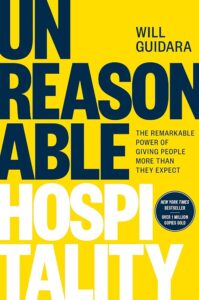
Other books you may enjoy:
Other notable books by the author:
← Book Summary: “Confessions of a Public Speaker”Linchpins for Living: 70 Life Lessons You Can Start Using Today to 10X Your Life →
