Book Summary: “Storyworthy”
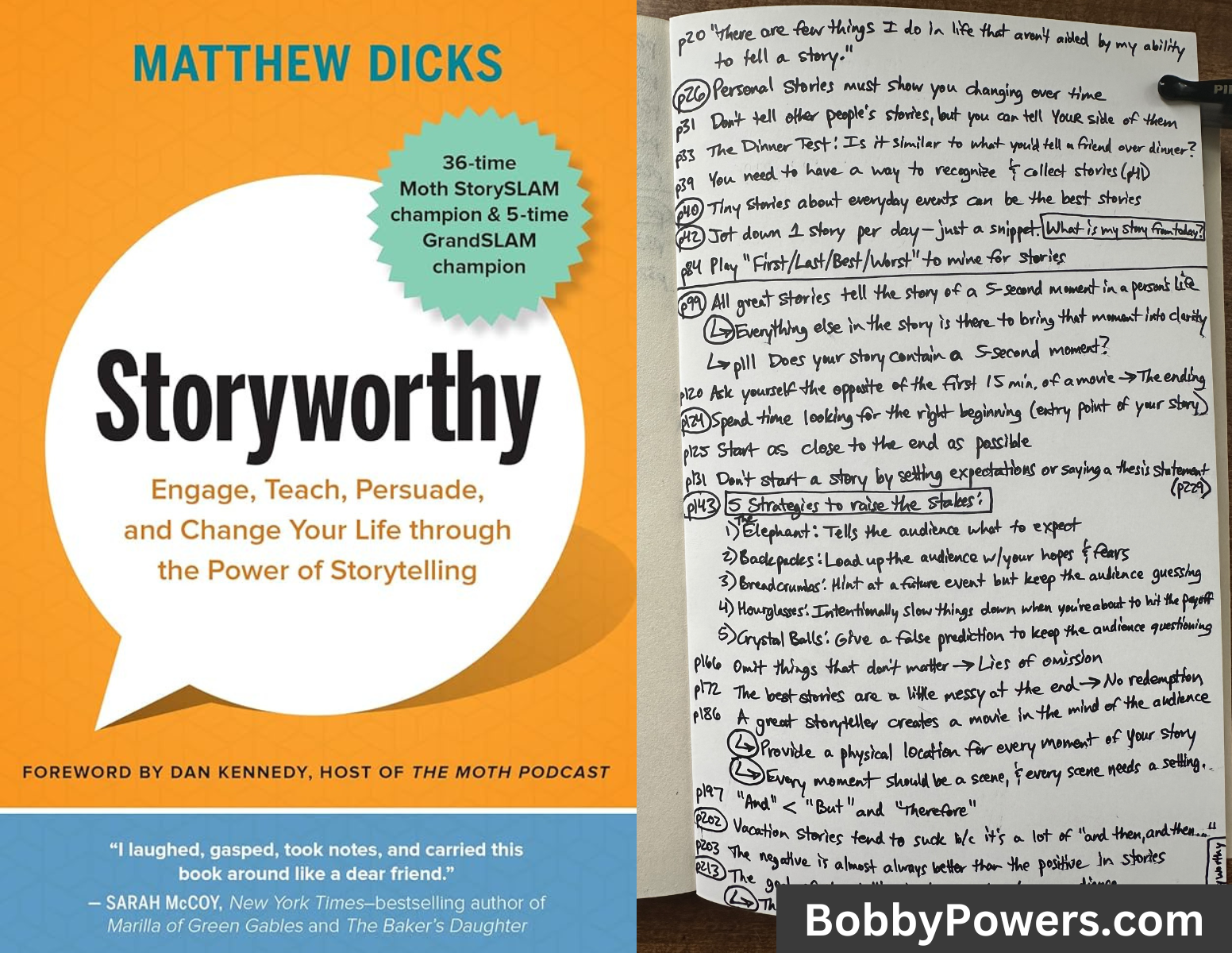
I write in the back cover of every book I read, as shown above.
To learn more about my book notes system, click here.
Book: Storyworthy by Matthew Dicks
Reviewer: Bobby Powers
My 3 Biggest Takeaways
1️⃣ Tell stories in the present tense and provide lots of sensory information
- The present tense conveys a sense of immediacy.
- "The present tense acts like a temporal magnet, sucking you into whatever time I want you to occupy."
- "There's one more benefit to the present tense: It helps you see your story...Seeing your story as you tell it is a great thing. It will help you connect to it more effectively. Your emotional state will more closely match your actual emotions from the time and place that you are describing. When you can see your story, it is more likely that your audience will see your story too."
2️⃣ Small moments often make better stories than big moments
- Tiny stories are relatable. You don't need a big, wild, crazy moment for each story you share. You just need an everyday moment that people can relate to.
- "Every great story ever told is essentially about a five-second moment in the life of a human being, and the purpose of the story is to bring that moment to the greatest clarity possible."
- "These five-second moments are the moments in your life when something fundamentally changes forever. You fall in love. You fall out of love. You discover something new about yourself or another person. Your opinion on a subject dramatically changes. You find forgiveness. You reach acceptance."
3️⃣ Write down one story from your life every day
- Learn to recognize and capture good stories that happen to you in your life
- "Storytellers need to know how to tell a good story, but they also need good stories to tell. Lots of them."
- "I needed to find these little moments. I needed to hunt them down. My goal was to identify the small stories that existed in my life already."
- "I decided that at the end of every day, I'd reflect upon my day and ask myself one simple question: If I had to tell a story from today—a five-minute story onstage about something that took place over the course of this day—what would it be?"
"I promise that whatever you do, storytelling will help...there are few things I do in life that aren't aided by my ability to tell a story." -Matthew Dicks
Selected Quotes & Ideas from the Book
- Matthew's background
- He didn't grow up in a family of storytellers or go to school to become a storyteller.
- He learned it by doing it and watching others.
- Now he's a 36-time Moth StorySLAM champion and 5-time GrandSLAM champion
- "No one ever made a decision because of a number. They need a story." -Daniel Kahneman
- 3 Rules of telling good personal stories
- CHANGE: "Your story must reflect change over time. A story cannot simply be a series of remarkable events. You must start out as one version of yourself and end as something new. The chance can be infinitesimal."
- YOUR STORY ONLY: "You must tell your own story and not the stories of others...There is immediacy and grit and inherent vulnerability in hearing the story of someone standing before you. It is visceral and real...Don't tell other people's stories. Tell your own. But feel free to tell your side of other people's stories, as long as you are the protagonist in these tales."
- THE DINNER TEST: "Lastly, the story must pass the Dinner Test. The Dinner Test is simply this: Is the story that you craft for the stage, the boardroom, the sales conference, or the Sunday sermon similar to the story you would tell a friend at dinner? This should be the goal...If you wouldn't tell your story at dinner that way, for goodness' sake don't tell it onstage that way. Storytelling is not theater."
- "Understanding that stories are about tiny moments is the bedrock upon which all storytelling is built, and yet this is what people fail to understand most when thinking about a story."
- "If I tell the story about the time I died on the side of the road and was brought back to life in the back of an ambulance, it's going to be challenging for an audience to connect with my story and with me. It might be exciting and compelling and even suspenseful, but audience members are probably not thinking, 'This is just like the time I died in a care accident and the paramedics brought me back to life!'"
- "This is why tiny moments like the one at my dining-room table with my wife and children often make the best stories. These are the moments that connect with people. These are the stories that touch people's hearts."
- Homework for Life -> Write down 1 story per day
- "I decided not to write the entire story down, because to do so would require too much time and effort...I would write a snippet. A sentence or two that captured the moment from the day. Just enough for me to remember the moment and recall it clearly on a later date."
- Ask yourself: "What is the thing about today that has made it different from any previous day?"
- First/Last/Best/Worst -> Great game to play to generate stories. Give yourself a prompt like "Kiss," "Car," "Travel," etc. and write the first, last, best, and worst one you can think of for that prompt.
- "Protect the time and space in which you write. Keep everybody away from it, even the people who are most important to you." -Zadie Smith
- "I spend a lot of time searching for stories...Not only are stories the currency I need to continue entertaining audiences, but more importantly, finding new stories both fills in and fills out my life."
- "The most powerful person in the world is the storyteller. The storyteller sets the vision, values and agenda of an entire generation that is to come." -Steve Jobs
- "I struggle to find the correct entry point to a story, and I believe that every story has a perfect entry point. The ideal place to start. More than half of the time I spend crafting stories is spent searching for the right beginning."
- 5 Strategies to increase the stakes in your story:
- The Elephant: Tell the audience what to expect -> Gives them a reason to listen and wonder
- Backpacks: Load up the audience with the hopes and fears you were experiencing in that moment of your story. -> Helps them wonder what will happen next and (hopefully) feel your same emotion.
- Breadcrumbs: Hint at a future event to keep the audience guessing -> Make them wonder what will happen
- Hourglasses: Slow down your story to a crawl right before you hit the story payoff -> Builds tension
- Crystal Balls: Give a false prediction in your story -> Prompts the audience to wonder whether that will happen
- As an example of "The Elephant," observe the difference between these two stories:
- Version 1: "My mother was the kind of woman whom everyone adored. The model of decorum and civility. She served as PTO president and treasurer of the ladies' auxiliary. She was the only female umpire in our town's Little League. She baked and knit and grew vegetables by the pound."
- Version 2: "I don't care how perfect my mother was. When I was nine years old, I wanted to disown her. Leave home and never return. Forget she ever existed. My mother was the kind of woman whom everyone adored. The model of decorum and civility. She served as PTO president and treasurer of the ladies' auxiliary. She was the only female umpire in our town's Little League. She baked and knit and grew vegetables by the pound."
- "A great storyteller creates a movie in the mind of the audience. Listeners should be able to see the story in their mind's eye at all times...to achieve this lofty goal, storytellers must do one thing, and happily for you, it's exceedingly simple: Always provide a physical location for every moment of your story."
- Version 1: "My grandmother's name is Odelie Dicks, which probably explains why she is who she is. She's a crooked old lady in both body and mind. She wears only dark colors and likes to serve food that has stewed in pots for days. I like to imagine that there was a time in her life when she smiled—or at least didn't scowl—but if that time existed, it was long before me."
- Version 2: "I'm standing at the edge of my grandmother's garden, watching her relentlessly pull weeds from the unforgiving soil. My grandmother's name is Odelie Dicks, which probably explains why she is who she is. She's a crooked old lady in both body and mind. She wears only dark colors and likes to serve food that has stewed in pots for days. I like to imagine that there was a time in her life when she smiled—or at least didn't scowl—but if that time existed, it was long before me."
- Version 1 is an essay. Version 2 is a story. The only difference is that v2 has a physical location.
- "If a director were filming the first version of my story, the movie would probably open on black. The description of my grandmother would be conveyed via voice-over. There's nothing for the audience to see, because no location is ever identified. It's almost impossible to imagine my grandmother, because there is no place to imagine her in."
- "In the second version, an image is instantly formed in your mind. A director would know exactly where to point the camera."
- "The secret to the big story: Make it little."
- "The goal of storytelling is to connect with your audience, whether it's one person at the dinner table or two thousand people in a theater. Storytelling is not about a roller-coaster ride of excitement. It's about bridging the gap between you and another person by creating a space of authenticity, vulnerability, and universal truth. If this is the goal (and it should be), then the big stories can get in the way of connecting."
- "This is the trick to telling a big story: it cannot be about anything big. Instead we must find the small, relatable, comprehensible moments in our larger stories. We must find the piece of the story that people can connect to, relate to, and understand."
- "Little moments hidden inside big moments. That's what we need to find to tell a big story well."
- Three helpful elements to create humor
- Surprise
- Milk Cans and a Baseball - "Refers to the carnival game where metallic milk cans are stacked in a triangular formation and the player attempts to knock them down with a ball. In comedy, this is called setup and punch line. The milk cans represent the setup, and the ball is the punch line."
- Babies and Blenders - "The idea that when two things that rarely or never go together are pushed together, humor often results."
- "Humor can be an enormous and essential asset to storytelling...But remember that humor is not necessary. There are many great stories that are entirely humorless but are still highly effective and beloved. Humor is optional. Heart is nonnegotiable."
- "Stories can never be about two things." You must choose one—and only one—point to make. That's because whatever you finish the story with (your 5-second moment) needs to be teed up with the exact opposite state of the world in the beginning of the story.
- "Ask yourself why you do the things that you do." -> The answer can sometimes point you toward deep emotion and a potential 5-second moment.
- "There is nothing wrong with sharing your success stories, but they are hard stories to tell well. The truth is this: failure is more engaging than success."
- "Tragic first-date stories are far better than perfect first-date stories."
- "The story of an F is almost always better than the story of an A+."
Think you’d like this book? Buy it here:
Other books you may enjoy:
- Talk Like TED by Carmine Gallo
- Building a Story Brand by Donald Miller
- Made to Stick by Chip and Dan Heath
Other notable books by the author:
← Book Summary: “It Doesn’t Have to Be Crazy at Work”Wise Words from Wise People (March 2026 Edition) →
