Book Summary: “Building a Story Brand”
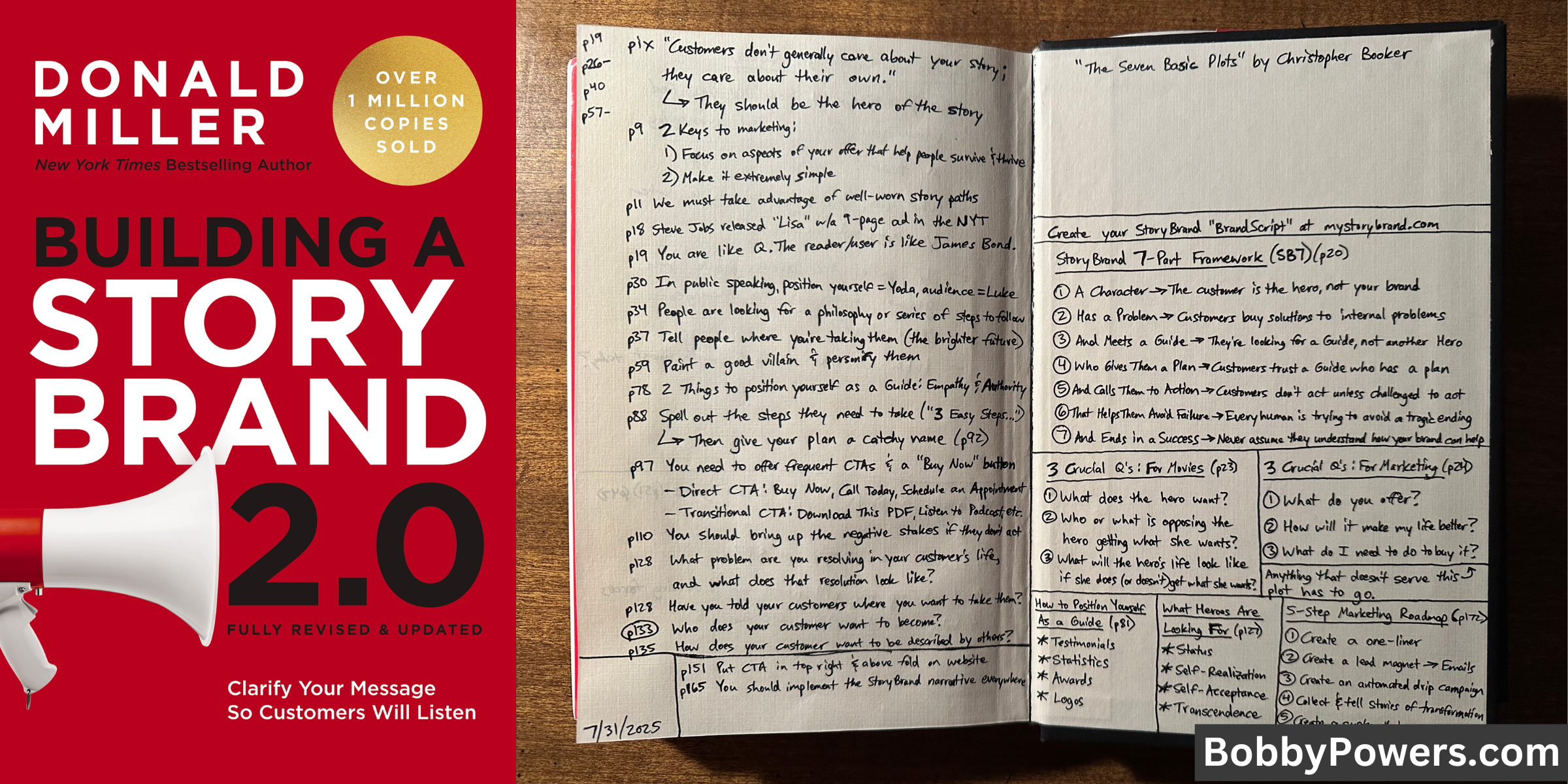
I write in the back cover of every book I read, as shown above.
To learn more about my book notes system, click here.
Book: Building a Story Brand by Donald Miller
Reviewer: Bobby Powers
My 3 Biggest Takeaways
- Every great story (including company/brand stories) follows the same 7-part story framework (the parts in CAPS below):
- "Here is nearly every story you see or hear in a nutshell: A CHARACTER who wants something encounters a PROBLEM before they can get it. At the peak of their despair, a GUIDE steps into their lives, gives them a PLAN, and CALLS THEM TO ACTION. That action helps them avoid FAILURE and ends in a SUCCESS."
- We must take advantage of well-worn story paths. The best stories have been told thousands of ways throughout history. Screenwriters, marketers, and storytellers continue to use them because they work.
- "Every human being is already speaking the language of story, so when you begin using the SB7 Framework, you'll finally be speaking their language."
- The customer should always be the hero of the story—not you.
- "Customers don't generally care about your story; they care about their own."
- It's similar to this principle of public speaking: "Recognize that you are Yoda, not Luke. The most important people in the room are your audience: Make them the heroes of your story." -Nancy Duarte
- "People don't buy the best products; they buy the products they can understand the fastest."
- For this reason, your website has to be stupid simple. "If you confuse, you'll lose."
- "The idea here is that customers need to know what's in it for them right when they read the text (at the top of your website). The text should be bold and the statement should be short."
- "Take a look at your website and make sure it's obvious what you can offer a customer."
- "There are two main places we want to place a direct call to action. The first is at the top right of our website and the second is in the center of the screen, above the fold."
- "For best results the 'Buy Now' buttons should be a different color from any other button on the site (preferably brighter so it stands out)."
"Anything that doesn't serve the plot has to go...In every line of copy we write, we're either serving the customer's story or descending into confusion; we're either making music or making noise." -Donald Miller
The StoryBrand 7-Part Framework (SB7)
"Here is nearly every story you see or hear in a nutshell: A CHARACTER who wants something encounters a PROBLEM before they can get it. At the peak of their despair, a GUIDE steps into their lives, gives them a PLAN, and CALLS THEM TO ACTION. That action helps them avoid FAILURE and ends in a SUCCESS."
- A Character
- Principle: The customer is the hero, not your brand.
- Has a Problem
- Principle: Customers buy solutions to internal problems.
- And Meets a Guide
- Principle: They're looking for a Guide, not another Hero.
- Who Gives Them a Plan
- Principle: Customers trust a Guide who has a plan.
- And Calls Them to Action
- Principle: Customers don't act unless challenged to act.
- That Helps Them Avoid Failure
- Principle: Every human is trying to avoid a tragic ending.
- And Ends in a Success
- Principle: Never assume people understand how your brand can change their lives. Tell them.
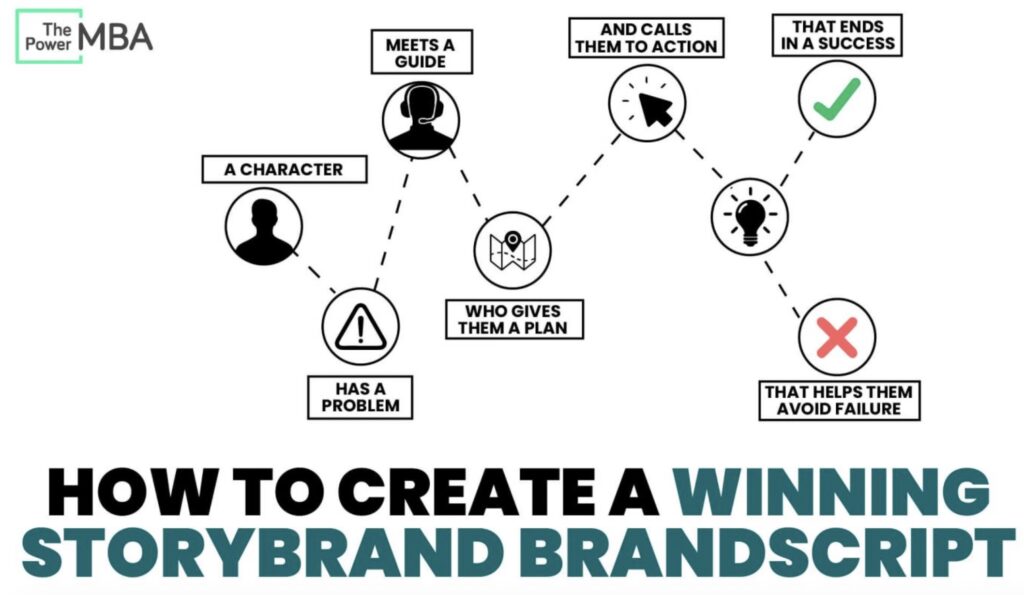
Image Source: ThePowerMBA.com
Selected Quotes & Ideas from the Book
- There are 2 keys to marketing:
- Focus on aspects of your offer that help people survive and thrive
- Make it extremely simple
- In 1983, Steve Jobs announced the Lisa computer with a 9-page ad in the NY Times, complete with a massive listing of its technical specs.
- He was soon ousted as Apple CEO because the company was struggling to make sales and connect with customers.
- Later, he learned the power of telling simple stories and focusing on the customer's desired hero story rather than his company's feature set. He became one of the best marketing minds in business history.
- "When Jobs returned to the company after running Pixar, Apple became customer-centric, compelling, and clear in their communication. The first campaign he released went from nine pages in the New York Times to just two words on billboards all over America: Think Different."
- "Notice, though, the story of Apple isn't about Apple; it's about you. You're the hero in the story, and they play a role more like Q in the James Bond movies. They are the guy you go see when you need a tool to help you win the day."
- 3 Crucial questions in movies/stories:
- What does the hero want?
- Who or what is opposing the hero getting what she wants?
- What will the hero's life look like if she does (or does not) get what she wants?
- 3 Crucial questions in marketing:
- What do you offer?
- How will it make my life better?
- What do I need to do to buy it?
- A good story is "life with the dull parts taken out." -Alfred Hitchcock
- "People are looking for a philosophy they can embody or a series of steps they can take to solve their problems."
- "If there is nothing at stake in a story, there is no story. Likewise, if there's nothing at stake in whether or not I buy your product, I'm not going to buy your product."
- Even though your product/service may solve MANY different problems for your audience, you need to pare down your focus to a single painful problem you solve for them. You may be able to talk about more problems later, but for now, you need to choose ONLY ONE.
- You connect with your customers by talking about problems they face. Introduce conflict.
- "The more we talk about the problems our customers experience, the more interest they will have in our brand."
- "Readers want to fret." -James Scott Bell
- "If we want our customers' ears to perk up when we talk about our products and services, we should position those products and services as weapons they can use to defeat a villain. And the villain should be dastardly."
- Empathy and Authority are the two things a brand must communicate to their audience (Hero) to position themselves as the Guide.
- How to express your authority without bragging or looking too much like the Hero:
- Testimonials
- Statistics
- Awards
- Logos
- You need to give your Hero a simple plan that helps them think to themselves, "Oh, I can do that. That's not hard." That's what motivates someone to click "Buy Now." There are 2 types of basic plans:
- Process Plan: Follow these simple steps (example: "3 Easy steps to XYZ")
- Agreement Plan: Agreement you make with your customers to help them overcome their fear of doing business with you (example: CarMax has a 4-point agreement which includes a no-haggle promise)
- "Once you create your process or agreement plan (or both), consider giving them a title that will increase the perceived value of your product or service. For instance, your process plan might be called the 'easy installation plan' or the 'world's best night's sleep plan.' Your agreement plan might be titled the 'customer satisfaction agreement' or even 'our quality guarantee.' Titling your plan will frame it in the customer's mind and increases the perceived value of all that your brand offers."
- You need to offer frequent, explicit calls to action (CTAs). There are 2 general types, and you should use both:
- Direct CTAs: Buy Now, Schedule an Appointment, Call Today
- Transitional CTAs (lower risk, usually offers something for free to keep the potential customer engaged): Download this PDF, watch this webinar, listen to this podcast, read this testimonial
- "Decide what direct call to action you want to make obvious on all your marketing material. Brainstorm any transitional calls to action you can create that will stake a claim to your territory, create reciprocity with your customers, and position your brand as a guide."
- "As it relates to our marketing, the obvious question is: What will the customer lose if they don't buy our products?...We don't bring up the negative stakes enough and so the story we're telling falls flat. Remember, if there are no stakes, there is no story."
- What's the cost of NOT doing business with you? Examples for a financial advisor:
- Confusion about how your money is being invested
- Not being ready for retirement
- A lack of transparency from your financial advisor
- A lack of one-on-one interaction with your advisor
- Hidden fees
- "We must tell our customers what their lives will look like after they buy our products, or they will have no motivation to do so. We have to talk about the end vision we have for their lives in our keynotes, in our e-mail blasts, on our websites, and everywhere else."
- "The three dominant ways storytellers end a story is by allowing the hero to:
- Win some sort of power or position.
- Be unified with somebody or something that makes them whole.
- Experience some kind of self-realization that also makes them whole."
- "Most companies earn 70 percent or more of their revenue from a small percentage of their clients."
- "What problem are you resolving in your customer's life, and what does that resolution look like? Stick to basic answers because basic answers really do work."
- "If we don't tell people where we're taking them, they won't follow. A story has to go somewhere. Have you told your customers where you want to take them?"
- Questions to ask yourself about your customers:
- Who does our customer want to become? What kind of person do they want to be?
- What is their aspirational identity?
- How does your customer want to be described by others?
- And can you help them become that kind of person? Can you participate in their identity transformation?
- You can create a StoryBrand BrandScript (which integrates all of the information above) at www.mystorybrand.com.
- "The BrandScript you've put together has to show up on websites, in e-mail campaigns, elevator pitches, and sales scripts. You must edit existing marketing materials and create new and better materials, then get those materials in the hands of potential customers."
- The 5 Things your website should include:
- An offer above the fold
- Obvious calls to action
- Images of success
- A bite-sized breakdown of your revenue streams
- Very few words
- "There shouldn't be a single words, image, or idea shared on your website that doesn't come from the thoughts generated by your StoryBrand BrandScript."
- "Your BrandScript can also be leveraged to transform employee engagement. And that has enormous implications for your company culture."
- "Stories hinge on conflict, so we should never shy away from talking about our customers' challenges."
- Helpful formula for nurturing emails:
- Talk about a problem.
- Explain a plan to solve the problem.
- Describe how life can look for the reader once the problem is solved.
- 5 Questions to generate great customer testimonials:
- What was the problem you were having before you discovered our product?
- What did the frustration feel like as you tried to solve that problem?
- What was different about our product?
- Take us to the moment when you realized our product was actually working to solve your problem.
- Tell us what life looks like now that your problem is solved or being solved.
- "It's true: if you confuse, you'll lose. But if you clarify your message, customers will listen."
Think you’d like this book? Buy it here:
Other books you may enjoy:
Other notable books by the author: