Book Summary: “What to Make of a Life”
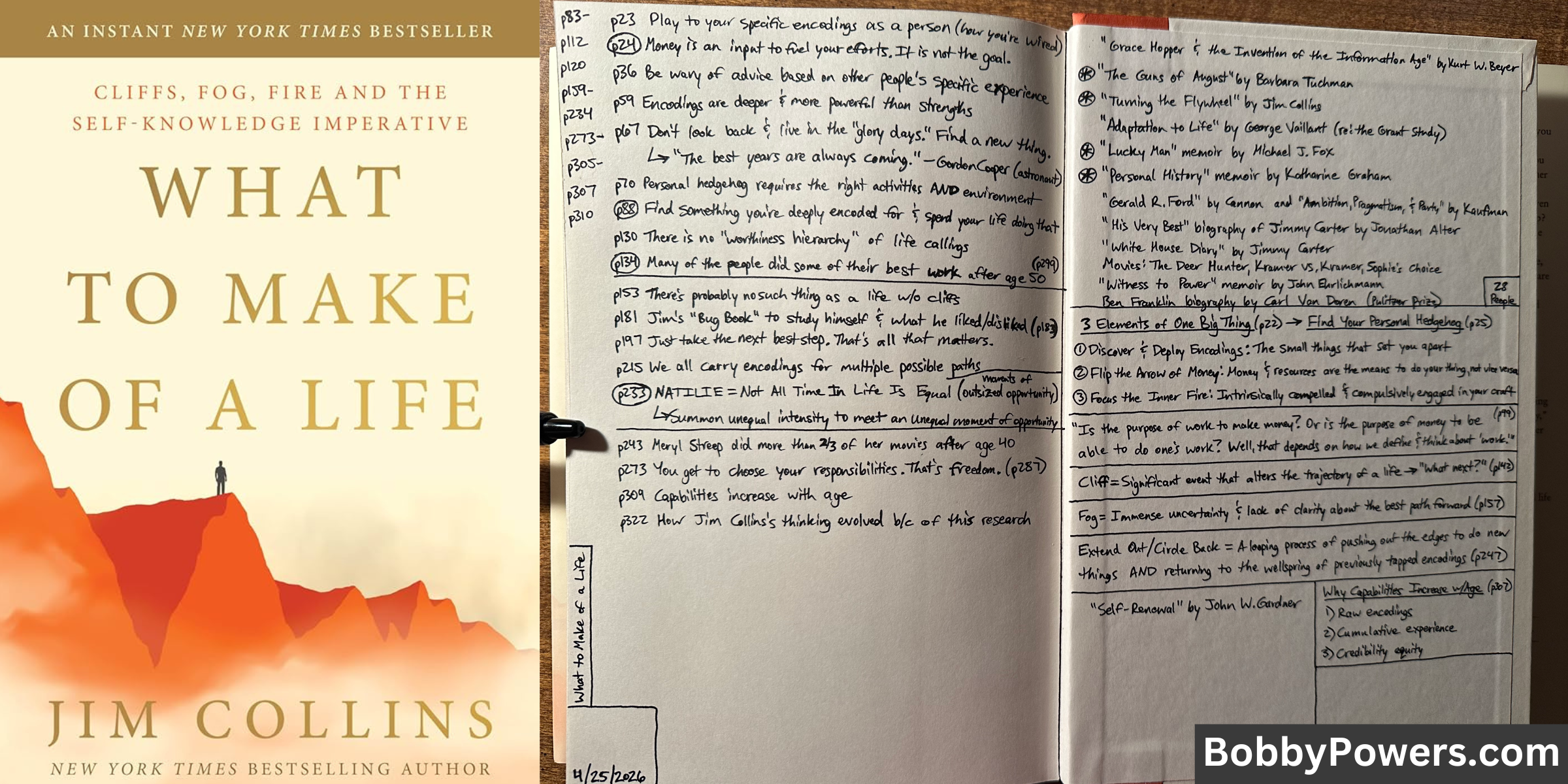
I write in the back cover of every book I read, as shown above.
To learn more about my book notes system, click here.
Book: What to Make of a Life by Jim Collins
Reviewer: Bobby Powers
My 3 Biggest Takeaways
 One of the most impactful things you can do in your life is to "flip the arrow of money"
- "Every person in our study made this flip at some point in their lives, from seeing money principally as the output of their efforts ('I work to make money') to seeing money as an input to fuel their efforts ('I need money to do what I'm encoded for')."
- "None of the people in our study measured their lives primarily by the amount of money they made. Not one. Yet equally true, they all understood that they needed to make the economics of their lives work."
- “Is the purpose of work to make money? Or is the purpose of money to be able to do one’s work?”
 Contrary to popular opinion, many people do their best work in their 60s, 70s, and even 80s.
- "These lives devastate the myth that our younger selves must tower over our older selves, that our best, most creative phase of life necessarily comes in the first half. One of my favorite findings is how many of them did some of their most significant and groundbreaking work well past the midpoint of their lives, sometimes well into their sixth, seventh, even eighth and ninth decades."
- Examples: Both Barbara Tuchman and Toni Morrison "produced more than 40% of their major books after the age of 60." And Meryl Streep has done more than 2/3 of her movies after age 40.
 Everyone has "encodings" (skills you're suited for that go beyond mere "strengths")
- "You don't create encodings; you discover them. You don't add encodings from without; you find them within."
- "Everyone has encodings. The question is this: Which encodings will the journey of life lead you to discover, and will you trust them enough to align your life around them?"
- "Even highly accomplished people can languish when they operate contrary to their encodings, when they fall out of frame."
"There is a big difference between being in love with the idea of one's work and being in love with doing the work itself. It means not just the love in the 0.001% highlight moments; it means love in the other 99.999%." -Jim Collins
Selected Quotes & Ideas from the Book
- Collins's research process for this book
- "As I began the research for this book, I confronted a fundamental problem: how to construct a systematic study that might yield new insights on the timeless questions of life. I needed a structured method."
- "I finally settled upon constructing pairs of people matched at cliffs, then studying their lives up to the cliff, through the cliff, then after the cliff. A cliff is a significant event that alters the trajectory of life and forces choices about what's next."
- "Cliffs are a powerful way to glean insight into the question of what to make of a life because life-altering cliffs force people to reconsider the question anew."
- Collins and his research team finally selected 34 people to systematically study and profile.
- Cliffs
- Cliff = "A significant event that alters the trajectory of a life and forces choices about what's next."
- "I realized that the odds any of us will complete a life without cliffs are close to zero. Some cliffs are bigger than others, but life is punctuated by cliffs."
- Fog
- Fog = "When you go through a phase of immense uncertainty and lack of clarity about the best path forward"
- "Episodes of fog—when people find themselves feeling lost or confused or befuddled or disoriented—can roll in at any point in life, but they are particularly prevalent in the wake of cliffs."
- "Fog is not a defect. It is an artifact of life."
- Three Elements of Finding Your One Big Thing (Your Personal Hedgehog)
- Discover and Deploy Encodings
- Flip the Arrow of Money
- Focus the Inner Fire
- Discover and Deploy Encodings
- Encoding = What you are uniquely suited to do
- "Encodings are deeper and much more powerful than mere 'strengths.'"
- "You cannot plan or think your way into a life lived perfectly in line with your encodings. Discovering encodings requires trial and error, experimentation, missteps, happy accidents, and disappointment."
- Focus the Inner Fire
- "Imagine being so intrinsically compelled by what you do that it feels almost unfair to receive rewards and recognition for doing it. Imagine being so compulsively engaged that you wish there were more hours in the day, and more days in a life, so that you could do even more of it. Imagine the thing you are doing feels almost more important than life itself."
- "Imagine having such an unquenchable enthusiasm for what you do that you might seem childlike to those around you."
- "I've come to see that for individual lives it is more about feeling intrinsically compelled than about being fanatically disciplined."
- Personal Hedgehog
- "To find a personal hedgehog means that you've found an arena of activity that meets three tests: (1) You're encoded for it; (2) you flip the arrow of money in doing it; and (3) it focuses the inner fire. To be in hedgehog mode means you've committed to organize your life and channel a huge chunk of your energy toward the pursuit of this One Big Thing."
- "Be wary of advice based on other people's specific experience. The advice might be well meaning, and perhaps even inspiring, but it might reflect their own encodings, which differ from your encodings."
- "One view of the world argues for a two-phase approach to life: success to significance. First achieve success, then do something significant and meaningful. This study leads me to a very different approach: First discover a set of encodings, then trust that full commitment to a hedgehog built around those encodings is in itself a meaning-filled answer to the question of what to make of a life."
- "When you find something you are deeply encoded for and that ignites a raging fire within, the greatest reward for doing your work is the opportunity to continue doing it."
- "Whatever anyone else thinks about me is none of my business." -Michael J. Fox
- "Do all things not for glory, but for joy." -Tenley Albright
- The Bug Book
- Just like a scientist would study a bug and take notes about their behavior in a book, Collins decided to do the same thing to study his own behavior.
- "I decided to use working at HP as a personal laboratory to study myself, or more precisely, to study myself like a bug."
- "I wrote 'Jim' on the front of the lab notebook, not to designate that the book is owned by Jim but that the subject under study is Jim. And I began making notes about 'the bug called Jim.'"
- Example: "I'd note that I was much more curious about the grand history of how Hewlett and Packard started and built a company than I was about how to work within the immediate confines of HP."
- "I discovered something essential: The bug named Jim was made to research, learn, make sense of things, wrap concepts, build frameworks of understanding, and then teach for impact."
- "Not all time in life is equal. Some moments count more than other moments, when what you do in that moment has an outsized impact on the trajectory of a life."
- "Acting is my way of investigating human nature." -Meryl Streep
- "Don't confuse the need for a break with the need to quit."
- "You see, the point is that freedom is choosing your responsibility. It's not having no responsibilities; it's choosing the ones you want." -Toni Morrison
- "Having lived long, I have experienced many instances of being obliged by better information or fuller consideration to change opinions, even on important subjects, which I once thought right but found to be otherwise. It is therefore that the older I grow, the more apt I am to doubt my own judgment and pay more respect to the judgment of others." -Benjamin Franklin
- "You cannot straighten out the road behind you."
- "Leadership is the art of getting people to want to do what must be done."
- "If someone offers you a leadership recipe based on what worked for them, remember that it worked for them because it reflected their encodings, which likely differ substantially from your own encodings."
Think you’d like this book? Buy it here:
Other books you may enjoy:
Other notable books by the author:
- Built to Last (co-written with Jim Porras)
- Good to Great
- Great by Choice
← Wise Words from Wise People (April 2026 Edition)16 Exciting Nonfiction Books Dropping in Q2 & Q3 2026 →
