Book Summary: “The Way of Excellence”
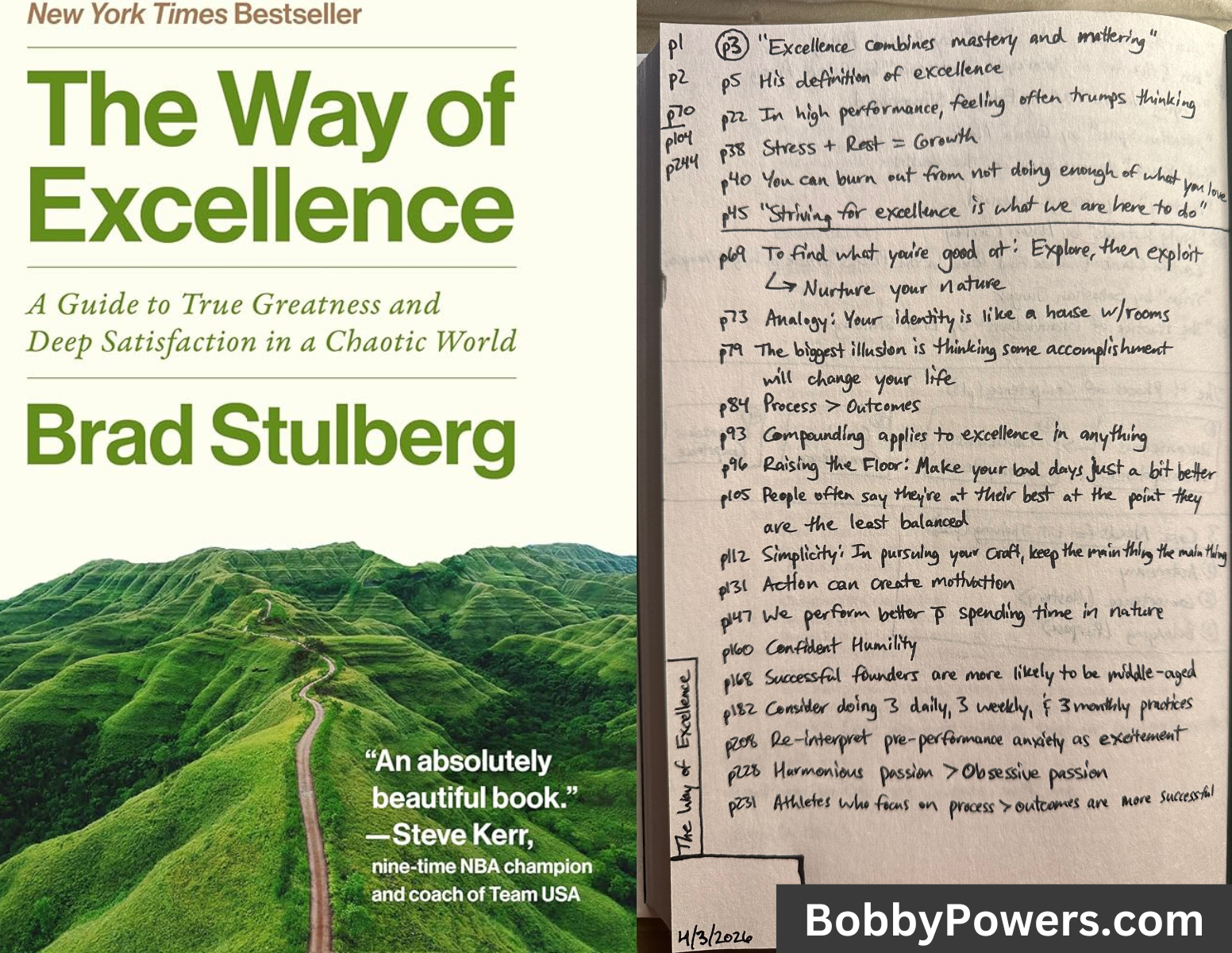
I write in the back cover of every book I read, as shown above.
To learn more about my book notes system, click here.
Book: The Way of Excellence by Brad Stulberg
Reviewer: Bobby Powers
My 3 Biggest Takeaways
1️⃣ Pursuing excellence in any field is one of the most fulfilling aspects of life
- Excellence = "An ongoing process of growth and becoming that imbues life with meaning and vigor. It emerges from involved engagement in something worthwhile that supports your values and goals."
- "Much of what ails us—distraction, automation, mechanization, burnout, isolation, alienation, and emptiness—can be overcome by the pursuit of excellence."
- "We have an innate drive for progress and growth. It's why we feel so alive when we channel that drive into meaningful goals—be it starting a business, writing a book, learning an instrument, studying a craft, or training for a marathon. Excellence is less a destination and more an energizing process of growth and becoming—an ongoing path that yields our best performances and, every bit as important, our best selves."
2️⃣ Excellence is more about feeling than thinking
- "Feelings are indispensable to excellence—they play a significant role in telling us when we are on the right track: We don't think our way to excellence as much as we feel our way to excellence."
- The highest level of excellence at a craft is "unconscious competence," when you're just operating off intuition and feeling rather than thinking your way through every step.
3️⃣ Accomplishing goals doesn't change your life, but striving for them does
- "There is no greater illusion than thinking the accomplishment of some goal will change your life. What will change your life is how you are transformed in the process of going for it. When you select what goals to pursue, you are selecting what kind of person you want to become."
- "Keep in mind that the real reward isn't just what happens when you reach the top of the mountain. It's who you become on the sides."
"We are at our best when we are: Working without distraction on something that matters to us. Creating and contributing to the world. Engaging deeply with others. Sufficiently challenged. Using our unique skills. In a state of relaxed productivity. Giving something our all. In the presence of beauty." -Brad Stulberg
Selected Quotes & Ideas from the Book
- "Excellence combines mastery and mattering."
- "The payoff is a deep internal satisfaction, a genuine self-respect based on effort and competence, a sense of aliveness and resonance that you won't find anywhere else."
- "A better alternative to obsessing over happiness is focusing on developing skills in worthwhile pursuits while opening your emotional aperture to a range of feelings along the way."
- Stress + Rest = Growth
- "The place to improve the world is first in one's own heart and head and hands, and then to work outward from there." -Robert Pirsig
- "The most raw and authentic pursuit of excellence begins to look a lot like love."
- "There are seeds of excellence in all of us. Our work is to discover which ones respond best to nourishment."
- "The goal is to build an identity house with at least a few rooms, because you never know when one is going to flood and you'll need to find strength and stability in the others."
- Consider establishing a "minimum effective dose": the amount of time you need to stay connected to each room in the house (meals with friends 2x/month, dinner with spouse every night at 5pm, exercise for at least 30 min/day, etc.).
- "So long as we are meeting our minimum effective doses, anything goes. When we are in on our main pursuit, we can really be in."
- The Arrival Fallacy = The idea that once we accomplish X, we'll have 'arrived' and we'll feel great
- "If you develop a mindset If I just do this, or just accomplish that, THEN I'll arrive, you are in for a rude awakening. We never arrive. The goalpost is always ten yards down the field. The human brain did not evolve to be satisfied. It evolved to strive."
- "We live under the illusion—well, the false hope—that once we make it, then we'll be happy." -Tal Ben-Shahar
- "Compounding doesn't just apply to excellence in investing. It applies to excellence in anything."
- "Progress is nonlinear."
- "You need to be a minimalist to be a maximalist. If you want to be really good, to master and thoroughly enjoy one thing, you need to say no to many others." -Michael Joyner, physician & researcher at Mayo Clinic
- "The times when people say they are at their best and feel most alive are also times when they are the least balanced."
- "The way you improve in anything is by eliminating distractions, prioritizing the fundamentals, and executing them with ruthless consistency."
- In each of your core endeavors, keep the main thing the main thing. Don't focus on new toys and fads. Focus on the basics. Keep things simple. If you want to become a better writer, write (rather than buying fancy writing pens, notebooks, software programs, etc.). If you want to become more healthy, work out and eat well (rather than focusing on fitness trackers and fad diets).
- "Action can create motivation."
- In a Univ. of Michigan study, participants who took breaks in nature outperformed those who took breaks in urban settings.
- "Many artists, knowledge workers, and craftspeople do their greatest work well into their fifties, sixties, and seventies."
- "Quality is a probabilistic function of quantity." -Dean Keith Simonton
- "If we keep showing up and producing, we improve the odds that eventually everything comes together."
- Consider developing 3 daily, 3 weekly, and 3 monthly practices that keep you grounded.
- In challenging situations, if you can figure out a way to put your brain into curious mode, it essentially will shut off your fear mode.
- "Curiosity is a formidable antidote to fear."
- "If the SEEKING and PLAY pathways are activated, then the PANIC and RAGE pathways are deactivated."
- "What's more, the neural circuitry associated with curiosity is like a muscle: It gets stronger with use."
- "Research shows the greats don't avoid nerves. They work with them." Example: Study of 200+ elite and non-elite swimmers:
- "Prior to the race, both the elite and non-elite swimmers experienced the same intensity of psychological and physiological arousal. The difference was that the non-elites viewed stress as something to avoid, ignore, or try to dampen...The elites, on the other hand, got curious about what they were feeling in their bodies and interpreted their sensations as neutral, if not aiding their performance."
- "Additional research published in the Journal of Experimental Psychology shows that instead of trying to calm ourselves before consequential events, such as public speaking, it's better to 'reappraise pre-performance anxiety as excitement.'"
- "Completion rituals imbue our journeys with meaning and significance."
- "We must protect time and space to step outside the day-to-day grind for reflection."
- "Nothing is more energizing and satisfying than giving our all to the activities we care about most."
Think you’d like this book? Buy it here:
Other books you may enjoy:
- So Good They Can't Ignore You by Cal Newport
- Peak by Anders Ericsson and Robert Pool
- Deep Work by Cal Newport
Other notable books by the author:
← Wise Words from Wise People (March 2026 Edition)The Top 5 Business Biographies I’ve Read (and What They Taught Me) →
