Book Summary: “Steve Jobs in Exile”
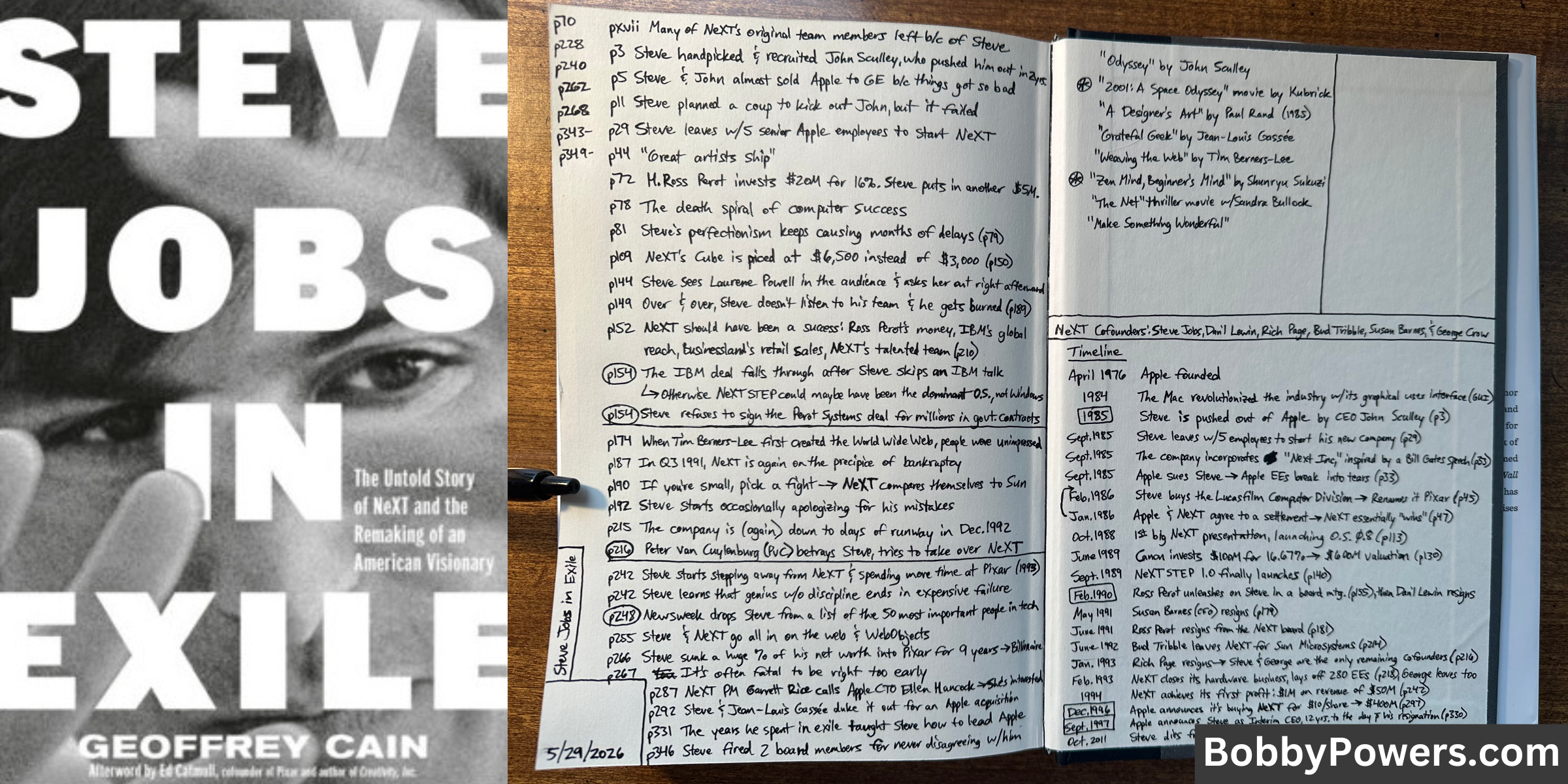
I write in the back cover of every book I read, as shown above.
To learn more about my book notes system, click here.
Book: Steve Jobs in Exile by Geoffrey Cain
Reviewer: Bobby Powers
I've read many biographies on Steve Jobs. Nearly every one of them briefly mentions Jobs's "wilderness years"—when he was booted out of Apple (his own company) and set off to create a new company called NeXT. That period of time is a footnote in most biographies, but Geoffrey Cain does it justice by devoting an entire (amazing) book to those 12 wilderness years.
This book is about the darkest period in Steve's career—during which he questioned himself, doubted his relationships, and sank the majority of his fortune into companies that were at the brink of failure (NeXT and Pixar).
As Cain's book reveals, this period of time is also what made Steve into the person who could captivate the world with breathtaking products like the iPod and iPhone.
During his time at NeXT, Steve often treated others poorly and failed to listen to the wise leaders he had hired. But by the time he rejoined Apple in 1997, he had learned from those mistakes and became not only a product genius but also a solid leader, willing to learn from his mistakes.
My 3 Biggest Takeaways
 Steve's later success at Apple was only possible because he learned from his mistakes.
- At NeXT, Steve often refused to listen to others on his team. Multiple times, employees cautioned him against pursuing various initiatives. He bulldozed ahead anyway and got burned by his decision.
- Ed Catmull (president of Pixar Animation) described Steve's path as "more like the hero's journey. He came back, he learned from the experiences and mistakes he made."
- "The lesson for the rest of us is clear: Don't attempt to emulate Steve's final form. Instead, embrace the work of personal transformation. Develop the intense curiosity to learn from mistakes and adjust course accordingly. Test your ideas against those of others. Be open to being proved wrong. Above all, when you fail, always be willing to begin again." -Ed Catmull
 Steve saw himself more as an artist than as a businessman.
- He saw every product as a chance to design something beautiful (not merely functional). That is rare, and it's the quality that ultimately led to his success.
- "My self-identity does not revolve around being a businessman, though I recognize that is what I do. I think of myself more as a person who builds neat things." -Steve Jobs
 "Genius without discipline ends in expensive failure."
- Cain says this is one of the lessons Steve learned from his time at NeXT.
- In the early days, Steve overspent on lavish details the company couldn't support, burning through significant cash.
- He eventually learned to temper his perfectionism with rational spending and occasional compromises. The result? A profitable business with killer products.

Selected Quotes & Ideas from the Book
- Timeline
- 1976 - Apple founded
- 1984 - The Mac revolutionized the industry with its graphical user interface
- 1985 - Steve is pushed out of Apple by CEO John Sculley
- Sept 1985 - Steve officially leaves the company with 5 other Apple employees (Dan'l Lewin, Rich Page, Susan Barnes, Bud Tribble, and George Crow) to start his new company (which becomes NeXT)
- Sept 1985 - Apple sues Steve, Apple employees break into tears at the division in the company and the difficulty of losing Steve
- Jan 1986 - Apple and NeXT agree to a settlement, NeXT essentially "wins" the lawsuit
- Feb 1986 - Steve buys the LucasFilm Computer Division and renames it Pixar
- Oct 1988 - Steve's 1st big NeXT presentation, launching their O.S. 0.8 (not a full beta)
- June 1989 - Canon invests $100M for 16.67% of NeXT -> $600M valuation
- Sept 1989 - NeXT STEP 1.0 O.S. finally launches
- Feb. 1990 - Ross Perot unleashes on Steve in a board meeting, then NeXT cofounder Dan'l Lewin resigns
- May 1991 - Cofounder Susan Barnes (CFO) resigns
- June 1991 - Ross Perot resigns from the NeXT board
- June 1992 - Cofounder Bud Tribble resigns and heads to Sun Microsystems
- Jan 1993 - Cofounder Rich Page resigns
- Feb 1993 - NeXT closes its hardware business, lays off 280 employees, cofounder George Crow also resigns (making Steve the only remaining cofounder at the company)
- 1994 - NeXT achieves its first profit: $1M on revenue of $50M
- Dec 1996 - Apple announces it's buying NeXT for $10/share ($400M)
- Sept 1997 - Apple announces Steve as interim CEO (iCEO) exactly 12 years to the day after he left the company
- Oct 2011 - Steve dies from pancreatic cancer
- When Steve left Apple to start NeXT with his 5 cofounders, he faced a lot of self-doubt: "As they worked through possibilities, Steve's confidence began to falter. He wondered aloud whether he had become washed up, an impostor, yesterday's visionary. He asked if he was doomed to spend the rest of his life wandering aimlessly."
- "Whenever you do any one thing intensely over a period of time, you have to give up other lives you could be living. You have to have a real single-minded kind of tunnel vision if you want to get anything significant accomplished." -Steve Jobs
- Andy Grove was a mentor to Steve Jobs. In summer 1991, Jobs invited Grove to join a NeXT offsite retreat. Grove walked in and asked the senior leadership team a seemingly simple question: "What business are you in?"
- "The executives glanced at each other. Andy waited." They gave different responses from each other.
- "'Andy asked profoundly simple questions,' NeXT's marketing director, Ron Weissman, recalled. But revealing ones. After six years in business, NeXT's own leadership couldn't agree on what business they were actually in."
- "John Sculley got a very serious disease. It's the disease of thinking that a really great idea is 90 percent of the work." -Steve Jobs
- "Larry (Ellison) operated like Steve did. They were both human magnets turned to maximum strength, either pulling people into their orbit or flinging them away. There was no neutral ground with either man."
- "[Steve] couldn't code, but he could grasp the essence of any technical problem instantly...He had a gift for connecting disparate ideas and suggesting combinations that violated conventional wisdom. He refused to accept the thousand reasons why something wouldn't work."
- "He cared about imparting a story, not building technology. 'No amount of technology can turn a bad story into a good story,' Steve later reflected."
- "The computer industry was littered with companies that had been right too early."
- "If you don't treat [talented workers] right, they can go get another job in ten minutes, right? So a strange thing happens, which is the sort of the hierarchy of power inverts, and the CEO is actually at the bottom. So I sort of feel like I work for most of these people, because they're the ones that are doing all the brilliant work, you know." -Steve Jobs
Think you’d like this book? Buy it here:
Other books you may enjoy:
Other notable books by the author: