Book Summary: “You Can Just Do Things” (Cate Hall)
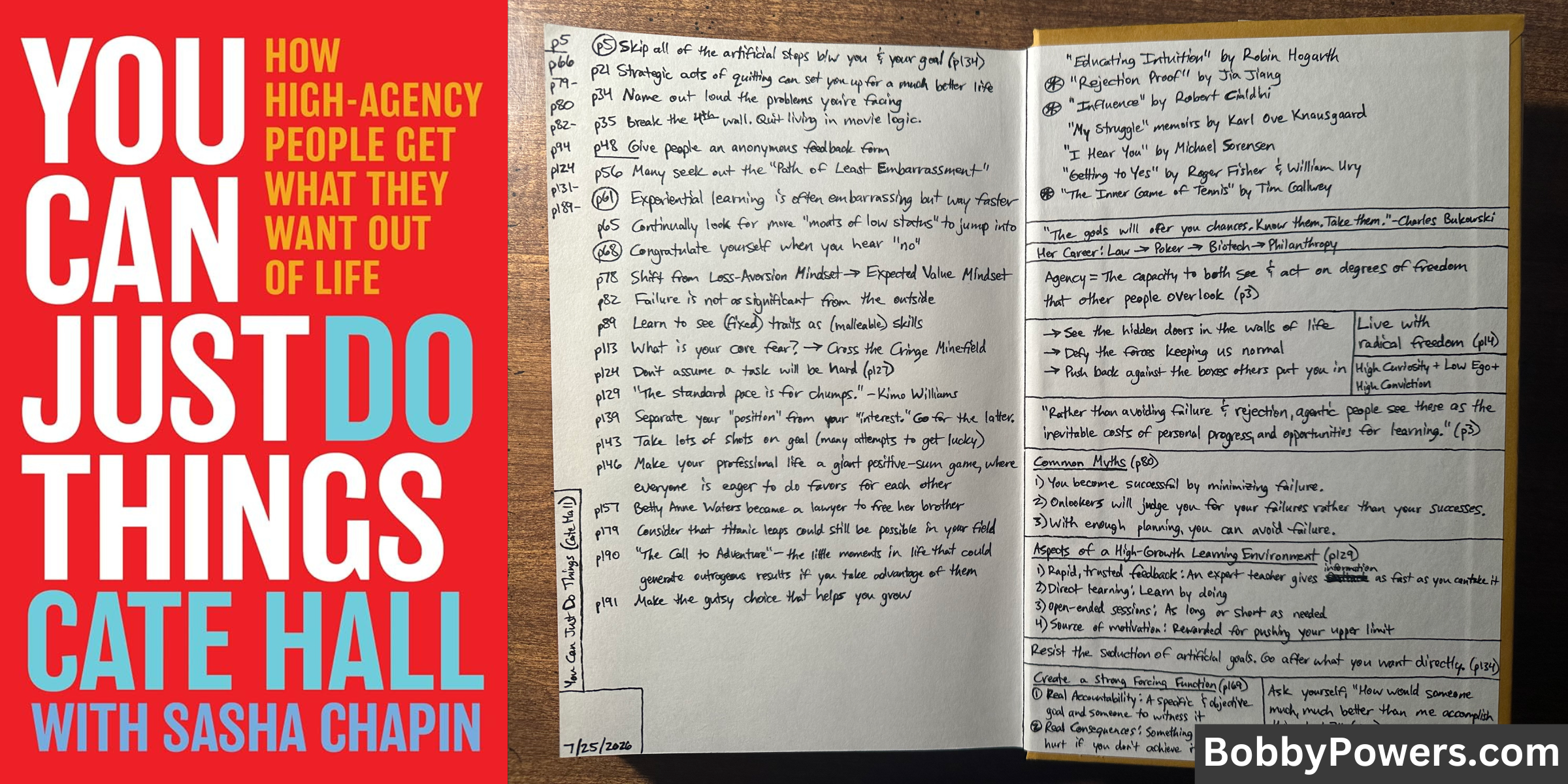
I write in the back cover of every book I read, as shown above.
To learn more about my book notes system, click here.
Book: You Can Just Do Things by Cate Hall with Sasha Chapin
Reviewer: Bobby Powers
My 3 Biggest Takeaways
1️⃣ Be willing to trudge through the Moat of Low Status
- "When you start learning or doing almost anything interesting, you will initially be bad at it, and incur a temporary penalty in the form of looking dumb or inept."
- "My husband calls this resistance to looking incompetent the 'Moat of Low Status.' Just like a business moat, it acts as a barrier to entry that keeps people who are already good at something safe from competition from the horde of people who could be good at it."
- "The fear of being seen even fleetingly as low-status stops human beings from living richer lives to an unbelievable degree."
- "We should always be looking for new Moats to jump into, even after we achieve competence, because this continual, self-inflicted humiliation is one thing that separates the good from the great."
2️⃣ Court rejection
- "Most of us carefully assess which requests that we might make are acceptable and which go too far. We avoid any request that's likely to generate social friction, behaving as if it would be immediately fatal to have a request denied."
- "When we treat rejection as an existential hazard, we are limited to a predictable existence. A more helpful point of view is that rejection is a form of information. When you experience rejection, you've learned that a given request won't work."
- "The high-agency mindset about rejection takes things even further. It says that you should seek out rejection, or at least welcome it. Congratulate yourself on hearing no. Remind yourself that if you don't routinely encounter rejection, you are not asking for enough—you're only making requests that are extremely likely to receive a yes."
- "I've found that the most efficient way to build these muscles is to make audacious requests."
3️⃣ View failure as the inevitable cost of progress and learning
- "In any event, failure is not as significant from the outside. To the outside eye, the course of life consists of the bright peaks achieved, with the long gray plateau of ordinary days edited away."
- "In short, failure is not particularly memorable unless you're the person learning from it. And knowing this can keep you sane when one of your projects is falling apart. You are the one inside it, feeling it most intensely, judging yourself for it most fervently."
- "If you're not failing all the time, you're not creating a situation where you can get super lucky." -Ira Glass
- Good mentality: "People don't really spend that much time noticing me and my failures, so I can probably try stuff."
"I think of agency as the capacity to both see and act on degrees of freedom that other people overlook. It's being able to see choices where others only see constraints—the hidden doors in the walls of life. It's also the courage to walk through those doors, to defy the forces keeping us normal—the pressures imposed by our inner script and by the boxes other people put us in." -Cate Hall
Selected Quotes & Ideas from the Book
- "Agency entails a radically different way of relating to the world. Rather than avoiding failure and rejection, agentic people see these as the inevitable costs of personal progress, and opportunities for learning."
- "Rather than taking it for granted that the experts have it under control, they expect that something more can be done, and that they can be the ones to do it. They choose to believe that everything is learnable, even traits and skills often believed to be innate, like charisma or curiosity."
- "Instead, I figured out how big a risk I could take without literally bankrupting myself and jumped straight into the deep end, trusting that I'd be able to figure it out."
- "Anytime you find yourself in the enviable position of actually knowing what you want out of life, you're allowed to skip all the artificial steps standing between you and it and work on your goal as directly as possible, doing only what matters to advance the plot."
- Stare into the abyss: "I'm suggesting that you take the time to engage in that intentional, intensive self-questioning. Call to your mind that big scary question that could shake up your way of being and dwell on it with a spirit of genuine inquiry."
- "How is social pressure constraining your real desires?"
- "What potentially true facts about the world do you refuse to consider because knowing them might require you to change your behavior?"
- "If you could go back to college and start over, would you still choose the same career path you're on now? The same partner or friends? If not, what's stopping you from changing them now?"
- "Imagine your child, or someone else you love, inherits your exact habits upon coming into adulthood. Which ones would you pay good money to delete from their life?"
- "Which talent or goal that you 'plan' to pursue have you made zero progress on in the last year? Why does it never make it to the top of the priority list?"
- Learning from feedback
- "When we hear something critical about ourselves, we typically have one of two instinctive responses: Reject it completely or accept it immediately as stated. In my experience, neither is optimal. To be good at receiving feedback, you need to look past binary responses."
- "To arrest this kind of knee-jerk response, work on mindfully refusing to look at things in black and white. Instead, embrace mental fluidity, examining all of the possibilities between 'they're completely wrong' and 'the worst-case scenario is true, and now I must die of shame.'"
- "In my experience, the habit of providing feedback enriches relationships, and is good for their durability. Many friendships fail over the long term due to some persistent annoyance that's not addressed. Every time you skirt around small frictions, you accumulate debt in the form of resentment. The debt grows, and for a while it might seem manageable, but then one day you just don't like the person anymore."
- The Path of Least Embarrassment = "It's our minds' tendency to automatically filter potential actions based on our intense fear of looking weird to other people. This causes us to underrate the effectiveness of unusual ways of acting."
- More info re: The Moat of Low Status
- You will probably sound awful at your first singing lesson. If you publish writing on the internet, your first piece will not be your best work. The only thing wrong with this is that we let it stop us
- "It's uncomfortable to learn a language by tripping over your words with native speakers, or to learn to climb by falling off a wall at the gym over and over again. As a result, we often turn instead to theoretical learning, even in domains where experiential learning is obviously faster."
- "If it's been a long time since I've felt the flush of embarrassment, I know I've slipped back into being too much of a rule follower."
- "'That looks dumb' is an accusation hurled at those who are actually doing stupid things. It's also hurled at those who are swimming through a Moat, leaving middling competence and heading toward unusual forms of greatness. I wish you the wisdom to know the difference, and the courage to act on it."
- "In many domains, elite performance is very different from merely good performance, and there is another moat of self-confrontation between those plateaus."
- "Judge talent at its best but character at its worst." -Lord Acton
- Learn to see traits as skills
- "I assume that most things we think of as fixed traits are actually quite malleable if we both believe they are and put the same effort into learning them that we would into learning anything else."
- "I'm absolutely willing to believe that there are limits to how far an assumption of malleability can take you. Just as it's relatively easy to change your weight but very difficult to change your height, personality traits probably lie on a spectrum of how readily changeable they actually are. I just don't find it particularly valuable to dwell on debates about the plasticity of specific characteristics. Instead, I find that adopting the belief that traits are changeable, working at them as though thy are, and seeing what happens is a much more useful way to approach life, one that will over the long term reliably yield more freedom than adopting the opposite belief."
- "Being a good manager, it turns out, requires more than demanding excellence; it also entails showing that you recognize it in others."
- Don't assume it will be hard
- "Most tasks are made more difficult by believing they will be difficult. When you assume that something is hard, it changes the whole way you approach it."
- "Have you ever been joyfully soaked by rain? There's that moment when you're caught in a rainstorm and you realize there's no avoiding it. You just give up and let the rain overwhelm you. In that moment, it suddenly becomes pleasant—which is odd, because nothing about the rain has changed. You just stopped fighting it. Assuming that something will be hard is like bracing against the rain."
- "'It can't be that hard' is a thought likely to occur most often to those who succeed at difficult things."
- "The standard pace is for chumps." -Kimo Williams
- "Resist the seduction of artificial goals and go after what you want directly."
- Ask yourself, "What is the simplest possible way I could get what I actually want?"
- "Take lots of shots on goal. It sounds stupidly simple, but it's profound: The more times you interact with the outside world, the more chances you have to get lucky—to find the collaborators, friends, and projects that, together, provide the right soil for you to bloom."
- "Remember that at any time, the latest information in a field won't be written down."
- "Another thing I've noticed about many people who've achieved outlier success: They are surrounded by people who they trust implicitly and who value competence and cooperation. Essentially, their professional lives are one giant positive-sum game, where everyone is eager to do favors for one another."
- "the gods will offer you chances. know them. take them." -Charles Bukowski
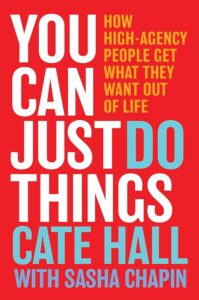
Think you’d like this book? Buy it here:

← Wise Words from Wise People (July 2026 Edition)The Best Nonfiction Books Coming Out Before the End of 2026 →
